
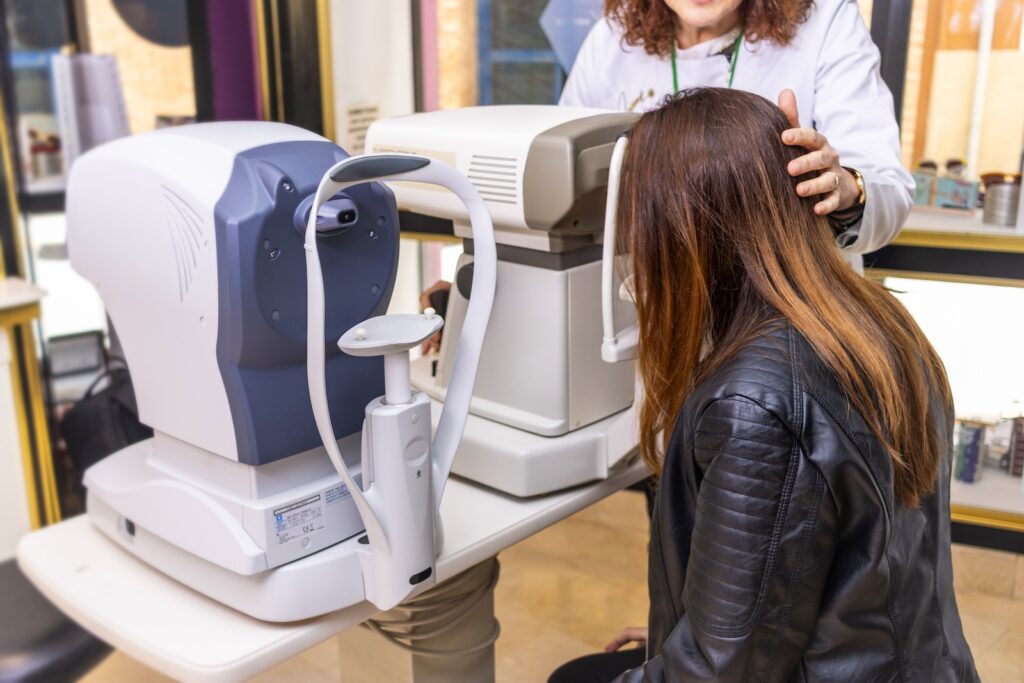
Eye surgery, be it cataract surgery, IVOM therapy or laser surgery, is a highly precise intervention in a very sensitive organ. The actual healing process only begins after the operation. A professionally supervised Aftercare following eye surgery has several key objectives:
The exact procedure of the Aftercare following eye surgery depends on the type of procedure. However, there is a general schedule that will give you some orientation.
Each procedure requires specific aftercare. The following table gives you an Overview about the special features of the most common operations we perform.
After glaucoma surgery (e.g. trabeculectomy, implants): We monitor the intraocular pressure closely in the first few weeks and manage the drug therapy to prevent scarring in order to ensure the long-term success of the pressure reduction.
After retinal and vitreous surgery: The control of the gas or silicone oil tamponade, the assessment of the retina and the coordination of further treatment (e.g. removal of the tamponade) are central here.
After eyelid and corneal surgery: This includes monitoring wound healing, managing stitches and adjusting local medication to prevent infection and reduce inflammation
Intervention | Typical duration of healing | Important rules of conduct in aftercare | Next check |
|---|---|---|---|
Cataract surgery | Visual acuity improves quickly, complete stabilization takes 4-6 weeks. | No pressure or rubbing on the eye no swimming pool/sauna for approx. 2 weeks. | On the first day after the operation, then after approx. 1 week and 4-6 weeks. |
IVOM (eye injection) | Short recovery phase of 1-2 days, the effect of the medication unfolds over weeks. | No rubbing, no contact on the day of treatment. No road traffic, no swimming pool, no sauna, do not press or rub the eye | 1st day post-op, then closely meshed, depending on the findings |
Retinal laser | Usually only minor impairment, possibly temporary glare or slight pain. Visual field defects that impair the ability to drive are possible. | Physical rest for a few days, in particular avoidance of shocks. | on the first day after laser to absorb possible pressure peaks, then after 1-2 weeks. |
Post-cataract laser (YAG) | Typical healing time: within a few days | As a rule, no special restrictions, possibly anti-inflammatory drops for a short time. | The next day, to absorb pressure peaks, then depending on the findings. |
Aftercare following eye surgery
Every operation requires specific aftercare. The following overview gives you an idea of the special features of the most common operations we perform.
1. Cataract surgery (cataract)
Typical healing time: Visual acuity improves quickly, complete stabilization takes 4-6 weeks.
Important rules of conduct: No pressure or rubbing on the eye, wear protective goggles at night, no swimming pool/sauna for approx. 2 weeks.
Next check-up: On the first day after the operation, then after approx. 1 week and 4-6 weeks.
2. IVOM (intravitreal eye injection)
Typical duration of healing: Short recovery phase of 1-2 days, the effect of the medication unfolds over weeks.
Important rules of conduct: No rubbing, no contact with tap water on the day of treatment, use prescribed drops.
Next check-up: Depending on the treatment plan, usually after 4-6 weeks to monitor success.
3. Retinal laser
Typical duration of healing: Usually only minor impairment, possibly temporary blinding or slight pain.
Important rules of conduct: Take it easy physically for a few days, especially avoid shocks.
Next check-up: Usually after 1-2 weeks to check the laser effect.
4. Post-cataract laser (YAG capsulotomy)
Typical healing time: Visual improvement usually occurs within hours.
Important rules of conduct: As a rule, no special restrictions, possibly anti-inflammatory drops for a short time.
Next check: Usually after approx. 1 week to check the pressure.
A successful Aftercare following eye surgery is teamwork. Your contribution is crucial for complication-free healing.
Contact us immediately in the event of severe pain, sudden deterioration in vision, redness or the perception of a shadow.
This is the most important measure to inhibit infection and inflammation. We will show you exactly how to do it.
Avoid rubbing or pressing on the eye. Wear sunglasses outside to protect against wind, dust and UV light.
Wash your hands thoroughly before touching anything near the eye (e.g. before dripping).
Light activities and office work are often possible again after just a few days. Depending on the operation, you should avoid strenuous sport, swimming or going to the sauna for 2-4 weeks. The exact recommendations for your individual Aftercare after eye surgery You can obtain this from Dr. med. Mareen Schmidt or Dr. med. Sebastian Schmidt.
A slight scratching or foreign body sensation in the first few days is normal and part of the healing process. An alarm signal would be if this feeling is accompanied by severe, throbbing pain, increasing redness and a deterioration in vision. In this case, you must undergo Aftercare after eye surgery contact us immediately.
Do not panic. Do not rinse the eye aggressively. Gently dab it dry and apply your prescribed antibiotic eye drops. Observe the eye. As long as there is no severe redness or pain, there is usually nothing wrong. If in doubt, give us a call. This is a common question in the Aftercare after eye surgery.
In order to minimize the risk of infection, you should avoid the following during the Aftercare after eye surgery completely avoid eye make-up (mascara, eye shadow, eyeliner) for at least one to two weeks. We will give you the green light as soon as the eye is free of irritation and healing has progressed far enough.
Wash your hands thoroughly. Tilt your head back slightly, gently pull the lower eyelid downwards and let a drop fall into the pocket thus formed without touching the tip of the bottle. Then close the eye slowly for about a minute. Correct application is crucial for the Aftercare after eye surgery.
The three most important alarm signals in the Aftercare following eye surgery are: 1. severe, increasing pain. 2. a sudden, marked deterioration in vision. 3. severe, increasing redness of the eye. If you experience these symptoms, you must contact us immediately at any time of the day or night.
Even if you feel well, complications can develop unnoticed. Only by examining you under the microscope can we objectively assess the healing process, check the eye pressure and ensure that everything is running smoothly. Attending your appointments is the most important contribution you can make to a safe Aftercare after your eye surgery can afford.





Check-ups, laser medicine, interdisciplinary ophthalmology

Retina, macular therapy, laser medicine, prevention & more

Address for the GPS:
Grüneburgweg 95 (corner of Liebigstraße), 60323 Frankfurt am Main.
Parking recommendations:
We recommend the following parking garages in the immediate vicinity:
Palmengarten parking garage: (Entrance via Siesmayerstraße). From there, it's about a 5-7 minute walk to the practice.
Campus Westend parking garage: (Entrance via Theodor-W.-Adorno-Anlage). Perfectly located for reaching the practice on foot in just a few minutes.
By bus (line 75):
Use the Bus route 75 and get off at the stop Eppsteiner Straße From there, it's only about a 2-3 minute walk (approx. 200 meters) along Grüneburgweg to the practice at the corner of Liebigstraße. Alternatively, you can use the bus stop. University Campus Westend to use.
By subway (U6 / U7):
Drive to the station Westend. Take the exit towards Feuerbachstraße/Liebigstraße. If you follow Liebigstraße straight ahead to the north, you will walk directly towards Villa Westend on Grüneburgweg (approx. 7-minute walk).
Alternative via the Palm Garden:
From the subway station Westend or the bus stop Palmengartenstrasse You can reach us after a short, pleasant walk past the Palm Garden.