Diabetes mellitus (diabetes) is a systemic disease that primarily damages the small blood vessels (capillaries) in the body. The Retina The (retina) in the eye is particularly susceptible to this type of damage.
Diabetic retinopathy is the most common and most serious eye complication of diabetes and the leading cause of blindness among people of working age in Germany.
Diabetes mellitus (diabetes) is a systemic disease that primarily damages the small blood vessels (capillaries) in the body. The retina in the eye is particularly susceptible to this type of damage. Diabetic retinopathy is the most common and most serious eye complication of diabetes and the leading cause of blindness among people of working age in Germany.
At our practice, we offer a comprehensive range of services that goes beyond mere diagnostics:
Interdisciplinary Collaboration: We work closely and regularly with Internal medicine specialists, diabetes specialists, and obesity specialists together to treat your systemic disease holistically.
Concomitant monitoring: We perform the mandatory retinal monitoring for patients who GLP-1 receptor agonists (such as the „weight-loss shot“) in order to detect rapid changes early on.
State-of-the-art diagnostics: We offer the full range of diagnostic services for diabetic retinopathy: Fundus photography, OCT, OCT-A, and fluorescein angiography for a precise assessment of the damage.
Individual Therapy: We provide the necessary treatments, such as Laser Treatments and IVOMs (intravitreal surgical drug administration) and, if necessary, refer patients for inpatient retinal surgery.
Holistic Approach: We Accept yourself just as you are, and we'll be there to support you on your journey to the best possible vision.
The retina is the eye's „film“—a highly complex layer consisting of millions of light-sensitive photoreceptor cells. Diabetes mellitus damages the smallest blood vessels throughout the body over time, including those in the retina. This damage is known as Diabetic retinopathy ... are referred to as. Retinal diseases often develop insidiously and unnoticed, but if left untreated, they can lead to severe and irreversible vision loss, even blindness.
Only regular, thorough examinations can detect these changes at an early stage. People with diabetes have a significantly higher risk of going blind due to retinal disease.
Chronically elevated blood sugar levels lead to two main problems:
Occlusion of blood vessels: The tiny blood vessels in the retina become blocked and die off. This leads to a reduced blood supply (ischemia).
Vascular Leakage: The blood vessel walls become permeable. Fluid and blood lipids leak out and accumulate in the tissue.
2. Diabetic Macular Edema (DME)
This is the most common cause of vision loss among people with diabetes:
Due to leakage from the blood vessels, fluid accumulates in the center of the retina, the Macula (Point of sharpest vision).
The swelling destroys the sensitive photoreceptor cells and leads to blurred vision and a decline in reading ability.
3. Proliferative retinopathy (late stage)
In response to the lack of oxygen, the retina produces a growth factor (VEGF). This stimulates the growth of new, abnormal blood vessels (Neovascularization).
These new vessels are very fragile and can easily lead to serious Vitreous hemorrhages.
You can also Scar Lines that lead to dangerous Retinal detachment can lead to.
Symptoms – Take Action Early!
The tricky thing is that diabetic retinopathy progresses in its early stages completely painless and symptom-free. Vision problems often do not appear until the disease is already advanced.
Be on the lookout for late warning signs:
Blurred vision or reduced visual acuity.
Distorted vision (Straight lines appear wavy.).
Sudden onset of black spots or „soot rain“ (Vitreous hemorrhages).
Difficulty seeing in the dark.
The most common and most serious condition is Diabetic Retinopathy (DR). This involves damage to the small blood vessels in the Retina (Retina) due to chronically elevated blood sugar.
People with type 1 diabetes should, for example, five years For the first follow-up appointment after the diagnosis. People with type 2 diabetes should immediately See an ophthalmologist after receiving a diagnosis, as the condition has often gone unnoticed for some time.
Yes, diabetic retinopathy is the the most common cause of blindness among people of working age. Important: Thanks to consistent monitoring and modern treatment (IVOM), this can now be achieved in the vast majority of cases prevents will be.
This is a Swelling (edema) in the Macula (the center of sharp vision) due to fluid leaking from damaged blood vessels. It is the main cause of Vision loss in people with diabetes.
The Macula is the central part of the retina responsible for the Visual Acuity (reading, recognizing details). The DMÖ is a Swelling (edema) of this central area, caused by fluid leaking from the damaged blood vessels.
Danger: This swelling severely impairs the function of the light-sensitive cells in the macula and leads to Distortions and a rapid loss of central visual acuity.
The Optical Coherence Tomography (OCT) is indispensable. It provides Cross-sectional views of the retina and enables millimeter-precise measurement of any Diabetic Macular Edema, which is essential for determining the course of treatment.
VEGF (Vascular Endothelial Growth Factor): This is a Growth factor, which is produced in excess when there is a lack of oxygen (ischemia). It is the main driver of two harmful processes:
It causes the vessels to leak (leading to DMÖ).
It stimulates the growth of new, abnormal blood vessels (Neovascularization) in the late (proliferative) stage of DR.
AGEs (Advanced Glycation End Products): These are harmful compounds that form when too much sugar binds to proteins and lipids. They are deposited in the vessel walls, causing them to stiffen, and contribute to the destruction of pericytes, thereby triggering DR.


Check-ups, laser medicine, interdisciplinary ophthalmology
Retina, macular therapy, laser medicine, prevention & more
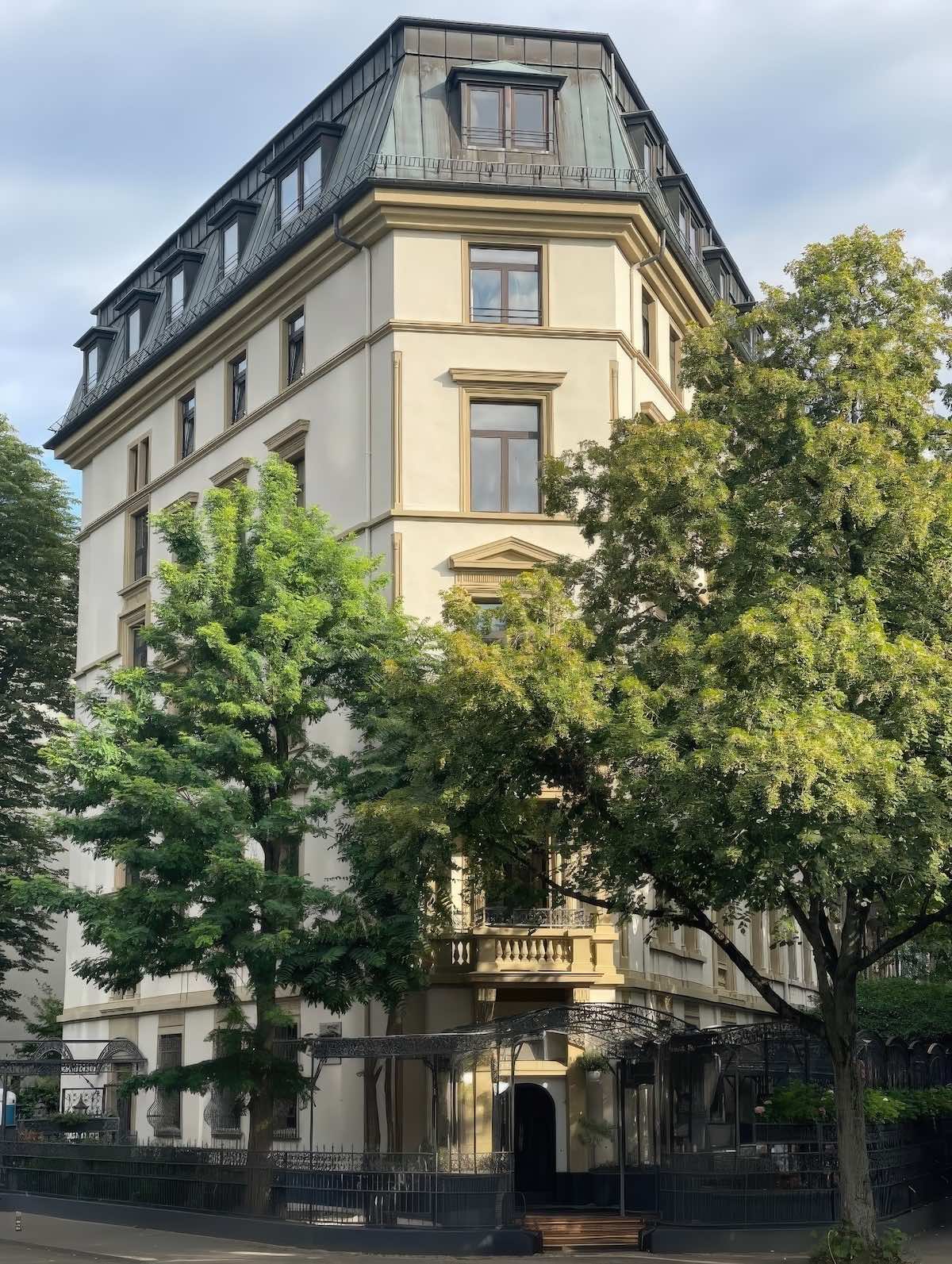
Address for the GPS:
Grüneburgweg 95 (corner of Liebigstraße), 60323 Frankfurt am Main.
Parking recommendations:
We recommend the following parking garages in the immediate vicinity:
Palmengarten parking garage: (Entrance via Siesmayerstraße). From there, it's about a 5-7 minute walk to the practice.
Campus Westend parking garage: (Entrance via Theodor-W.-Adorno-Anlage). Perfectly located for reaching the practice on foot in just a few minutes.
By bus (line 75):
Use the Bus route 75 and get off at the stop Eppsteiner Straße From there, it's only about a 2-3 minute walk (approx. 200 meters) along Grüneburgweg to the practice at the corner of Liebigstraße. Alternatively, you can use the bus stop. University Campus Westend to use.
By subway (U6 / U7):
Drive to the station Westend. Take the exit towards Feuerbachstraße/Liebigstraße. If you follow Liebigstraße straight ahead to the north, you will walk directly towards Villa Westend on Grüneburgweg (approx. 7-minute walk).
Alternative via the Palm Garden:
From the subway station Westend or the bus stop Palmengartenstrasse You can reach us after a short, pleasant walk past the Palm Garden.