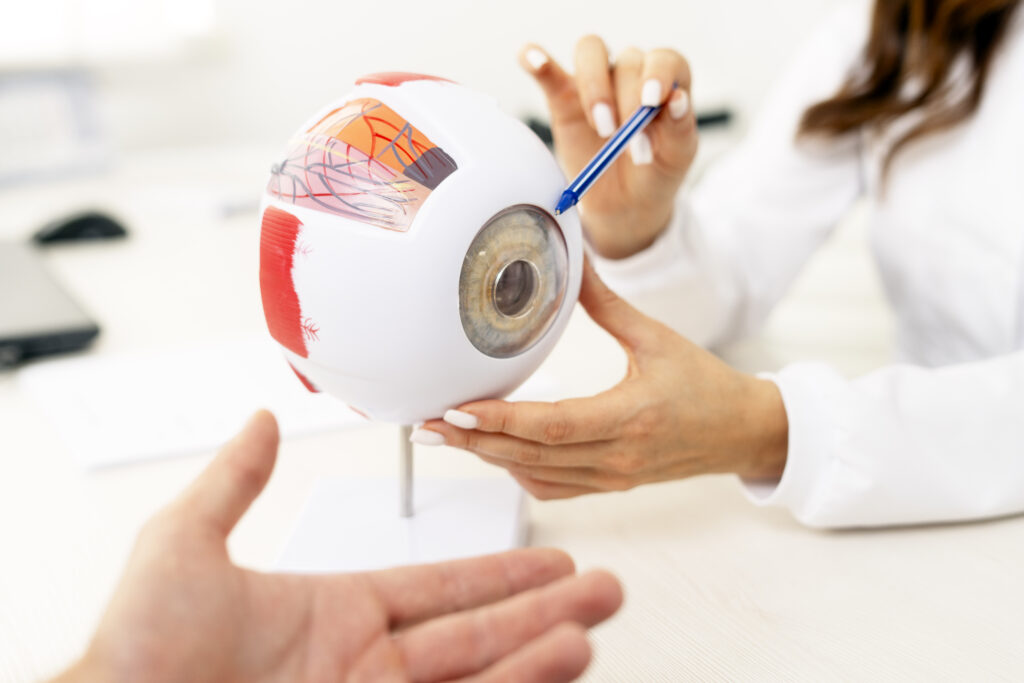
The treatment of diabetic macular edema at our Frankfurt practice is designed to effectively combat one of the most common and serious causes of vision loss in people with diabetes. Diabetic macular edema (DME) is a serious complication that threatens central vision, but thanks to modern therapies, it is now very treatable. As your experienced retinal specialist in the Westend district, Dr. Mareen Schmidt focuses on early diagnosis and individually tailored, guideline-based treatment. Diabetic macular edema treatment, to preserve your eyesight in the long term.
What is diabetic macular edema and why is treatment necessary?
Chronically elevated blood sugar levels damage the fine blood vessels in the retina of the eye (diabetic retinopathy).1 These blood vessels become brittle and permeable, similar to a porous garden hose. This allows fluid to leak from the vessels into the surrounding retinal tissue. When this fluid accumulation affects the macula, the point of sharpest vision in the center of the retina, it is called diabetic macular edema.2 This swelling disrupts the function of the highly sensitive photoreceptor cells.
The result is typical symptoms such as:
- Blurred or foggy vision
- Distorted vision (metamorphopsia), where straight lines appear wavy3
- Reading difficulties and recognizing details4
- Fading color perception
Without a targeted Diabetic macular edema treatment If this process continues, it can lead to severe and permanent damage to central vision.5
Modern diabetic macular edema treatment: IVOM therapy
By far the most effective and established Diabetic macular edema treatment Today, the most common treatment is IVOM therapy (intravitreal injection of medication), better known as "eye injections." In this procedure, highly effective medications, so-called VEGF inhibitors, are injected directly into the interior of the eye.6 Vascular endothelial growth factor (VEGF) is the main cause of increased vascular permeability in diabetes. Intravitreal injections (IVOM) specifically block this signaling molecule, thereby sealing the abnormal blood vessels, reducing swelling, and allowing the retina to recover. In many cases, this form of treatment can restore vision. Diabetic macular edema treatment not only stabilized, but even significantly improved.
Our 5-S method: Your guarantee for a safe and painless treatment
The idea of an injection in the eye is frightening. That's why we perform every Diabetic macular edema treatment The treatment is carried out according to our specially developed 5-S method. It is our promise to you for a treatment of the highest quality and comfort.
- Safe: Each injection is performed exclusively by Dr. med. Mareen Schmidt, an experienced retinal specialist, in compliance with the strictest medical protocols.
- Gentle: We take our time, create a calm atmosphere and carry out the procedure with the utmost care and precision.
- Low pain: Thanks to intensive, multi-stage local anesthesia with highly effective eye drops, the treatment is not painful for you.
- Sterile: Uncompromising hygiene in accordance with surgical standards minimizes the risk of infection, the most serious potential complication.
- Carefully: From comprehensive information and precise planning to close follow-up care, every step is monitored with the utmost care.
Complementary treatment options: The role of laser therapy
In addition to IVOM therapy, laser treatment (photocoagulation) can also play an important role in the Diabetic macular edema treatment play. While IVOM therapy treats swelling in the center, laser therapy is often used to treat peripheral retinal areas or to seal individual, clearly defined leakage points.
IVOM therapy vs. laser therapy: A comparison
Feature | IVOM therapy (eye injection) | Retinal laser (photocoagulation) |
Main goal | Fast and effective reduction of macular swelling. | Sealing of leaks, treatment of oxygen-depleted areas. |
Operating principle | Blockage of the VEGF messenger substance to seal the vessels. | Targeted destruction of tissue using thermal energy. |
Application in DME | Gold standard with centralized involvement, often with significant improvement in vision. | More likely used for swelling outside the center or to treat surrounding retinopathy. |
Treatment duration | Repeated injections at individualized intervals. | Several 15-minute sessions per eye |
Often, a combination of both methods is the best way to treat the various aspects of eye disease in diabetics. Diabetic ophthalmologist will determine the best strategy for you.
Their crucial role in the treatment of diabetic macular edema
The success of every Diabetic macular edema treatment Your active participation is crucial. The best ophthalmological therapy can only be successful in the long term if the underlying condition is optimally controlled.
- Optimal blood sugar control: A stable and well-controlled long-term blood sugar level (HbA1c) is the most important basis for slowing the progression of retinal damage.
- Consistent blood pressure control: Well-controlled blood pressure significantly reduces the strain on the delicate blood vessels in the eye.
- Therapy adherence: Consistent adherence to the agreed-upon check-up and treatment appointments at our practice is essential to ensure the success of the IVOM therapy.
Frequently asked questions about diabetic macular edema treatment
Here you will find answers to common questions that patients ask us as part of a Diabetic macular edema treatment in our Frankfurt practice.
Is the eye injection painful during the treatment of diabetic macular edema?
No, the treatment is not painful thanks to our low-pain 5-S method. The intensive numbing of the eye's surface with highly effective eye drops means you won't feel the insertion of the ultra-fine needle. Most of our patients describe the Diabetic macular edema treatment with a syringe as a short, light pressure, but not as pain, and are relieved after the first treatment.
How often does the treatment need to be repeated?
The Diabetic macular edema treatment Treatment is usually long-term. It often begins with a series of monthly injections to quickly reduce swelling. Subsequently, the treatment intervals are individually adjusted to your condition to keep the retina "dry" in the long term with as few injections as possible, but as many as necessary.
Can diabetic macular edema treatment cure the disease?
The Diabetic macular edema treatment While it can very effectively control swelling and improve vision, it does not cure the underlying diabetic retinopathy. As long as diabetes persists, the risk of swelling recurring remains. Lifelong monitoring and good metabolic control are therefore crucial to ensuring the success of the treatment.
What are the risks and side effects?
The most common side effects are harmless, such as a small red spot on the eye or a temporary foreign body sensation. The most serious, but extremely rare, complication is an infection inside the eye. Due to our strict sterile procedures during the treatment, this is highly unlikely. Diabetic macular edema treatment This risk is reduced to an absolute minimum to ensure your maximum safety.
Can my eyesight improve again?
The primary goal of Diabetic macular edema treatment The goal is to prevent further vision loss and stabilize the condition. In many cases, however, the reduction of macular swelling also leads to a significant and noticeable improvement in visual acuity and a decrease in bothersome distorted vision. Early treatment increases the chance of a good visual recovery.7
Are there alternatives to intraocular injections for the treatment of diabetic macular edema?
For the treatment of central diabetic macular edema, the Diabetic macular edema treatment Treatment with an intraocular injection is the worldwide gold standard and by far the most effective method. In certain cases, cortisone implants (also administered by injection) or supplementary laser therapy may also be beneficial. Currently, there are no tablets or eye drops that offer a comparable effect.
What happens if I refuse treatment?
Without a consistent Diabetic macular edema treatment The swelling of the macula usually progresses.8 The persistent fluid buildup leads to progressive and permanent damage to the photoreceptor cells. The result is a severe, irreversible loss of central vision, reading ability, and the ability to recognize faces.
Will my health insurance cover the costs of the treatment?
Yes, the Diabetic macular edema treatment Treatment with approved medications (IVOM therapy) is a recognized service and is usually covered by private health insurance companies.
How do I recognize diabetic macular edema?
Symptoms often develop gradually. Pay attention to blurred, foggy, or distorted vision. Don't wait for symptoms! An annual eye exam with your ophthalmologist is the only way to detect diabetic macular edema early. Timely detection is crucial. Diabetic macular edema treatment is crucial for success.
Why is a retina specialist so important for treatment?
The Diabetic macular edema treatment This requires the highest level of expertise in diagnostics (especially OCT interpretation) and in administering IVOM therapy. As an experienced retinal specialist, Dr. Mareen Schmidt possesses the necessary routine and expertise to optimally manage your condition, individually control treatment intervals, and offer you the safest and most effective therapy.
Your eye health in the best hands if you have diabetes
Diabetic retinopathy and macular edema are serious conditions, but thanks to modern therapies, the prognosis is significantly better today than it was just a few years ago. The key to success lies in regular checkups and consistent, early treatment. If you have diabetes, don't hesitate. Schedule an appointment for your comprehensive checkup. Diabetic macular edema treatment and preventative care in our Frankfurt practice.