
Early detection of glaucoma at our Frankfurt practice is the most important and effective measure to identify one of the most insidious eye diseases in time and prevent irreversible vision loss. Glaucoma, commonly known as the "silent thief of sight," damages the optic nerve gradually, painlessly, and often unnoticed for many years. At the ophthalmology practice of Dr. Mareen Schmidt in the Westend district, we rely on state-of-the-art, gentle diagnostic methods to provide you with a thorough and precise examination. Glaucoma early detection To give you the security your eyesight deserves.
Glaucoma early detection: Why it is so crucial for your eyesight
The greatest danger of glaucoma lies in its often undetected progression. The disease leads to the progressive destruction of the optic nerve fibers, resulting in gradual visual field defects. Because these defects typically begin at the periphery of the visual field, and central, sharp vision remains intact for a long time, those affected often only notice the disease when 40% or more of the optic nerve fibers have already been irreversibly damaged. It is precisely for this reason that the Glaucoma early detection The only way to diagnose the disease at an early, treatable stage is through testing. Once damage has occurred to the optic nerve, it cannot be repaired. Therefore, the goal of any treatment is to preserve the current condition – a goal that is more easily achieved the earlier we begin.
Early detection of glaucoma: Our diagnostic building blocks
A comprehensive and reliable Glaucoma early detection In our Frankfurt practice, our examination goes far beyond a simple measurement. It consists of several complementary components that together provide a precise picture of the health of your optic nerve and your individual risk. Each examination is performed according to the principles of our 5-S method: Safe, Gentle, Minimally Painful, Sterile, and Thorough.
- Intraocular pressure measurement (tonometry): Elevated intraocular pressure is the most important risk factor for developing glaucoma. We perform this measurement gently and without contact, without having to touch your eye directly.
- Assessment of the optic nerve head (ophthalmoscopy): Dr. Mareen Schmidt uses a special microscope to examine the optic nerve head, the point at which the optic nerve exits the eye. Typical glaucoma changes, such as an increasing hollowing („excavation“), can be detected here at an early stage.
- Corneal thickness measurement (pachymetry): The thickness of your cornea has an influence on the accuracy of the intraocular pressure measurement. By measuring the corneal thickness, we can individually correct the measured pressure value and assess it even more precisely.
- Optical coherence tomography (OCT) of the optic nerve: This is the most modern and precise method within the framework of Glaucoma early detection. This non-contact scan creates a micrometer-precise cross-sectional image of your optic nerve head and accurately measures the thickness of the nerve fiber layer.
- Visual field examination: detects damage caused by the loss of nerve fibers
A comparison of methods for glaucoma early detection
The following table provides an overview of the most important procedures and their respective contribution to diagnosis within the framework of a careful examination. Glaucoma early detection.
Examination procedures | What is measured/assessed? | Why is it important for glaucoma early detection? |
Tonometry | Intraocular pressure. | Identifies the most important treatable risk factor. |
Ophthalmoscopy | The appearance and shape of the optic disc. | Enables the doctor to directly visualize typical glaucoma damage. |
OCT of the optic nerve | The exact thickness of the nerve fiber layer in micrometers. | It detects the earliest structural damage, often years before other tests, and enables precise, objective monitoring of disease progression. |
Risk factors: Who should take glaucoma screening particularly seriously?
Although a Glaucoma early detection While it is generally recommended for every adult aged 40 and over, there are certain risk groups for whom earlier and more regular check-ups are particularly important in order to correctly assess the individual risk.
The most important risk factors include:
- Age: The risk increases significantly from the age of 40.
- Elevated intraocular pressure: The main risk factor.
- Family stress: If your parents or siblings have glaucoma, your personal risk is significantly increased.
- High nearsightedness (myopia): The optic nerve is more susceptible to pressure damage in very short-sighted eyes.
- Thin cornea: A thin cornea can increase the risk of glaucoma.
- Systemic diseases: In particular, diabetes mellitus or severe fluctuations in blood pressure can impair blood flow to the optic nerve.
The role of modern technology in the early detection of glaucoma
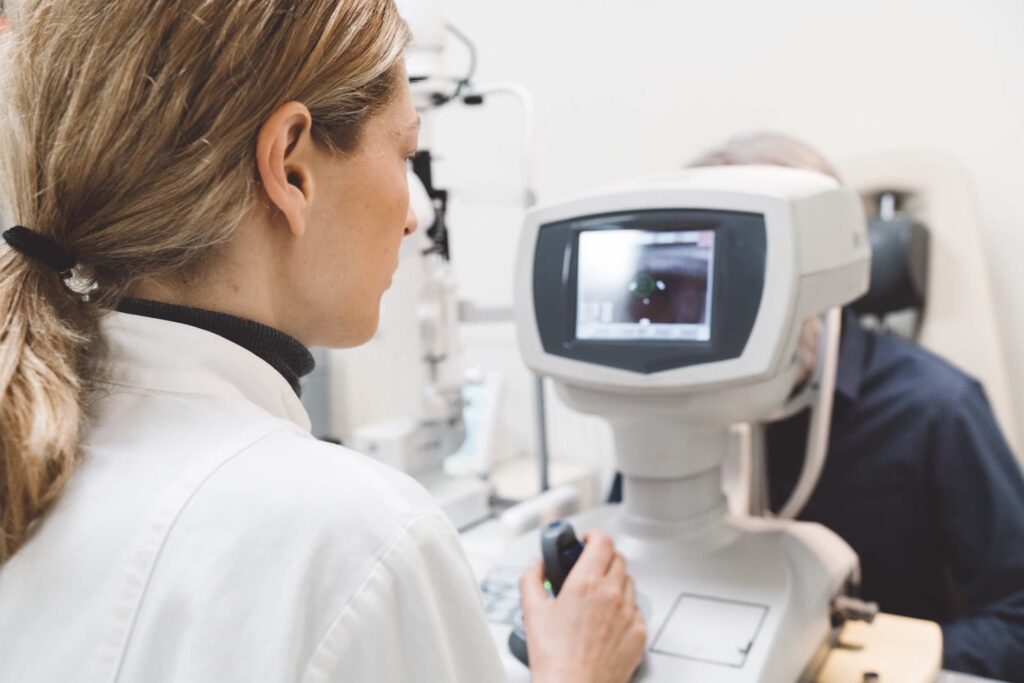
The biggest revolution in the Glaucoma early detection Optical coherence tomography (OCT) is a key development in recent years. While older methods like visual field testing only reveal deficits once a significant portion of the nerve fibers has already been destroyed, OCT can detect damage much earlier. It objectively and quantitatively measures the thickness of the nerve fiber layer and compares it to the values of a healthy, age-matched population. Progressive loss of this layer is the unmistakable sign of glaucomatous damage. This precise technology is a cornerstone of our meticulous approach and enables a Glaucoma early detection at the highest level.
Frequently asked questions about glaucoma screening
Here you will find answers to frequently asked questions about the early detection of glaucoma in our Frankfurt practice.
At what age is glaucoma screening advisable?
The ophthalmology professional associations recommend regular Glaucoma early detection For everyone aged 40 and over, as the risk increases significantly from this age. If risk factors are present, especially a family history of eye disease, the first examination should take place earlier. Starting preventative care early is the best protection for your eyesight.
Is the exam painful?
No, none of the studies conducted as part of the Glaucoma early detection It is painful. Modern intraocular pressure measurement is performed with a gentle puff of air and is contactless. OCT examination is also a purely scanning procedure, in which you simply look at a fixation light. Our gentle approach is part of our quality promise to you.
Will my health insurance cover the costs of glaucoma screening?
The Glaucoma early detection The cost is covered by private health insurance. We consider this examination one of the most important investments in the long-term preservation of your eyesight and will advise you transparently about the costs.
How often should I have the examination repeated?
The recommended interval for the Glaucoma early detection It depends on your age and your individual risk profile. If the results are normal and the risk is low, an interval of two years may be sufficient. However, if you have elevated risk factors or borderline results, annual checkups are advisable to detect any changes early and increase safety.
My intraocular pressure is normal. Am I safe from glaucoma?
No, unfortunately not. There is a form of glaucoma, called "normal-tension glaucoma," in which the optic nerve is damaged even though the intraocular pressure is within the statistically normal range. For this reason, pressure measurement alone is not sufficient for a reliable diagnosis. Glaucoma early detection not sufficient. The assessment of the optic nerve using examination and OCT is always the decisive factor.
What happens if something abnormal is found during early detection?
A notable finding in the Glaucoma early detection This is no reason to panic, but rather an opportunity to take action in a timely manner. Dr. Mareen Schmidt will discuss the findings with you in detail. Typically, a visual field test (perimetry) is then performed to check for any existing functional deficits. If the diagnosis is confirmed, treatment with eye drops can, in the vast majority of cases, stop or significantly slow the progression of the disease.
Is high eye pressure the same as glaucoma?
No, that's an important distinction. Elevated intraocular pressure is only the most significant risk factor, but not the disease itself. There are people with high pressure without damage (ocular hypertension) and people with damage despite normal pressure. Glaucoma early detection It aims to identify individual damage to the optic nerve, independent of the pure pressure value.
Can I contribute to early detection myself?
Since glaucoma causes no early symptoms, you cannot detect it yourself. Your most important contribution to Glaucoma early detection Regularly attending preventative appointments with an ophthalmologist is essential. A healthy lifestyle with good blood pressure control can support blood flow to the optic nerve, but it does not replace eye examinations.
What is the difference compared to an examination at an optician?
An optician is permitted and able to measure intraocular pressure. However, they lack the medical training and technical equipment to properly assess the optic nerve and make a diagnosis. A reliable Glaucoma early detection is a purely medical procedure and can only be performed by an ophthalmologist.
Why is OCT imaging so important for early detection?
OCT examination of the optic nerve is the greatest advance in modern medicine. Glaucoma early detection. It allows us to objectively measure the loss of nerve fibers numerically and compare it over time. This enables us to detect disease progression much earlier and more reliably than with the naked eye or a visual field test alone.
Protect your eyesight
A timely Glaucoma early detection Regular eye exams are the only way to prevent unnoticed vision loss due to glaucoma. Take your eye health seriously and invest in regular checkups. Schedule an appointment for a comprehensive and thorough preventative examination at our Frankfurt practice.