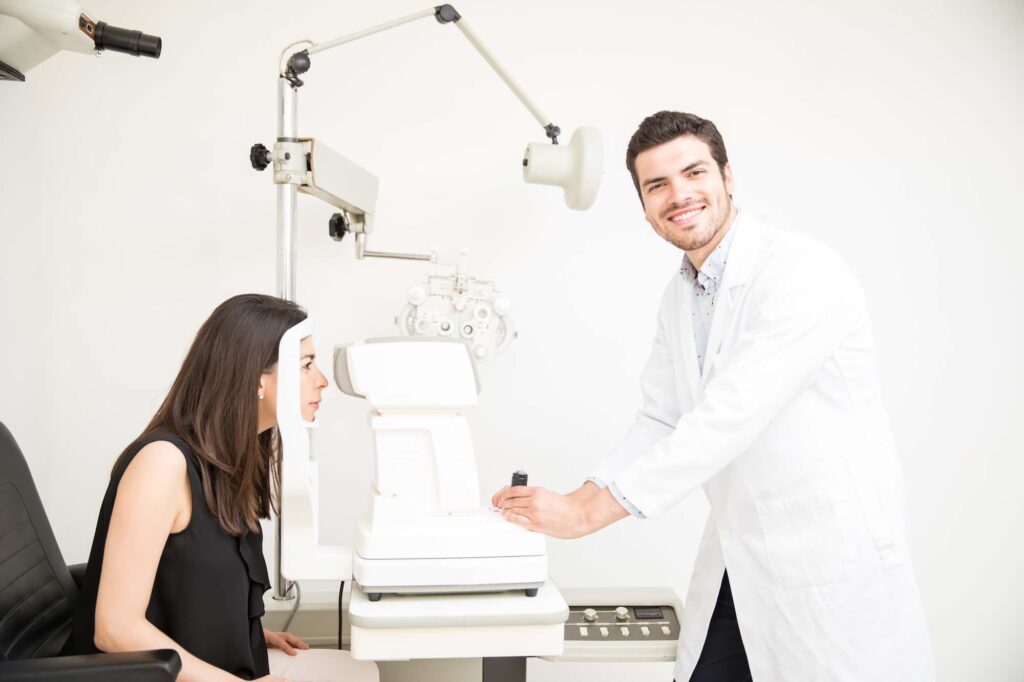
Intravitreal injections (IVOM) represent one of the greatest advances in ophthalmology of the 21st century and stand for the highly effective treatment of severe retinal diseases through targeted drug injections into the eye. Although the term may sound technical, it represents a safe and often vision-preserving routine treatment. At our ophthalmology practice in Frankfurt Westend, the IVOM medicine A core competency of Dr. med. Mareen Schmidt, who specializes in performing this modern therapy safely, painlessly and with maximum success for you, according to the highest quality standards.
IVOM Medicine: The abbreviation explained in simple terms
The IVOM medicine Intravitreal operative drug delivery is a medical term, the abbreviation for which stands for "Intravitreal Operative Drug Delivery". To alleviate any concerns you may have about the unfamiliar, we will break down this term step by step and explain what each part means for your treatment.
- Intravitreal: This word means „into the vitreous“. The vitreous is the clear, gel-like substance that fills most of the inside of your eyeball. By injecting the medication directly into this space, it reaches exactly where it is supposed to work without detours and in high concentration: the retina and the macula at the back of the eye.
- Operational: The term "operative" here primarily describes the conditions under which the procedure takes place. IVOM This procedure requires the highest level of sterility to minimize the risk of infection. It is therefore performed in the operating room. This procedure is solely for your safety.
- Drug administration: This describes the actual procedure. A highly effective medication is introduced specifically into the eye in order to stop or slow down a pathological process.
The IVOM medicine describes precisely a minimally invasive, highly sterile procedure for the direct treatment of diseases at the back of the eye.
The medical necessity: Why IVOM is used in ophthalmology
The IVOM medicine This is the research answer to a group of serious retinal diseases that, if left untreated, often lead to rapid and severe vision loss. The common denominator of these diseases is, in many cases, a naturally occurring messenger substance called VEGF (Vascular Endothelial Growth Factor). When there is a lack of oxygen or inflammation in the eye, this messenger substance is produced in excess and acts like a "fire alarm," triggering two harmful processes: It causes new, but abnormal and leaky, blood vessels to grow and makes existing vessels permeable. Both lead to fluid accumulation in the center of the retina (macular edema), which distorts and blurs vision. IVOM medicine intervenes specifically to interrupt this process.
The main areas of application of IVOM medicine
The IVOM medicine It has revolutionized the prognosis for several serious eye diseases. Its effectiveness has been proven by countless large scientific studies.
The most common indications for IVOM therapy are:
- Wet age-related macular degeneration (AMD): The most common indication.
- Diabetic macular edema (DME): A serious complication of diabetes in the eye.
- Macular edema after retinal vein occlusion: For the treatment of swelling after a „thrombosis“ in the eye.
- Inflammation inside the eye (uveitis): For rapid and targeted control of severe, non-infectious inflammatory reactions that threaten vision.
The IVOM procedure: A safe medical process according to the 5-S method
We are aware that the IVOM medicine This is something patients often worry about. That's why we've designed the entire process according to our patient-centered 5-S method. It guarantees you treatment that meets the highest standards of safety and comfort.
Principle of the 5-S method | What this means for medical procedures |
Safe | The indication is rigorously reviewed. The procedure is performed exclusively by an experienced specialist. |
Gentle | The procedure is performed with a steady hand and in a relaxed atmosphere to minimize stress. |
Low pain | Intensive, multi-stage local anesthesia with eye drops ensures a virtually painless experience. |
Sterile | Uncompromising hygiene according to surgical standards minimizes the risk of infection, the most serious potential complication. |
Careful | Every step, from education to implementation to aftercare, is monitored seamlessly and with the utmost precision. |
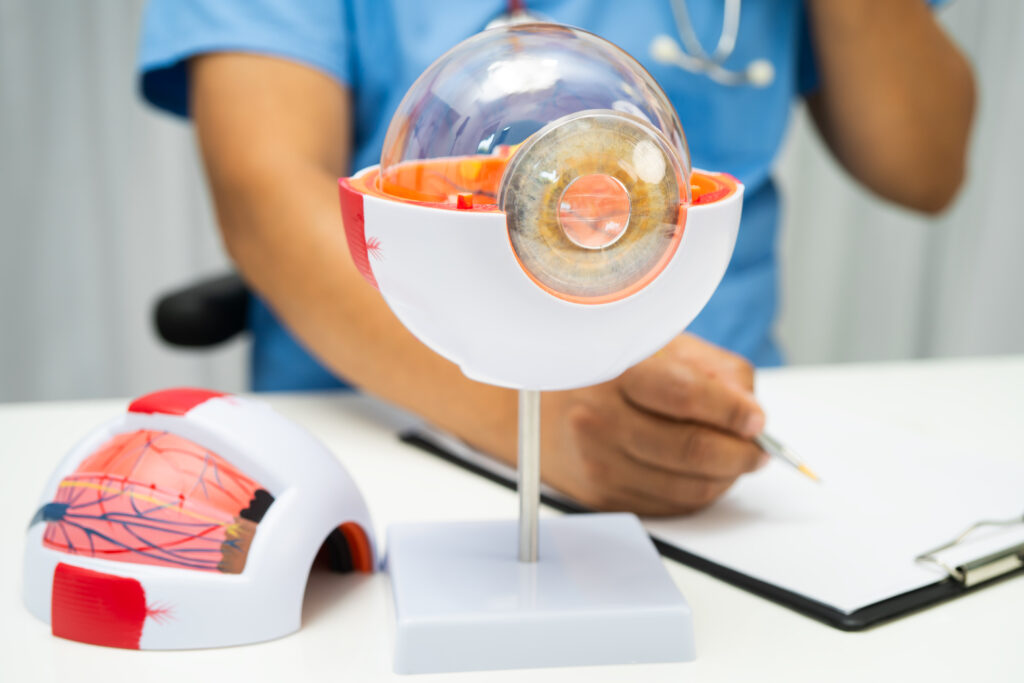
Frequently asked questions about IVOM medicine
Here you will find answers to frequently asked questions that patients ask us when they first encounter the topic. IVOM medicine be confronted with.
Is IVOM a "real" medicine?
Yes, absolutely. The ones at the IVOM medicine The active ingredients used are highly complex, biotechnologically produced antibodies or fusion proteins. They are among the most modern and targeted medications in all of medicine. Their development is based on decades of molecular biological research, and their efficacy was demonstrated in large, worldwide clinical trials before they were approved for use in the eye.
Why can't this medicine be taken as a tablet or eye drops?
The active ingredients of IVOM medicine These are large protein molecules. As tablets, they would be digested and destroyed in the gastrointestinal tract. As eye drops, they could not penetrate the eye's barrier to reach the retina in the posterior segment of the eye in a sufficient concentration. Direct injection is therefore the only way to safely deliver an effective dose of the medication to its site of action.
What type of medicine is used in IVOM?
In most cases of IVOM medicine So-called VEGF inhibitors are used. These include established medications such as Lucentis® (ranibizumab) and Eylea® (aflibercept), as well as state-of-the-art developments like Vabysmo® (faricimab). In specific cases, particularly with inflammation, cortisone preparations can also be administered as a depot implant (e.g., Ozurdex®). IVOM medicine be used.
Is IVOM a major operation, given that it is surgical?
No, although the term "operative" is included in the abbreviation, it is a minimally invasive procedure that only takes a few seconds. The operative nature of the IVOM medicine This primarily refers to the need for absolutely sterile conditions. For you as a patient, the procedure feels more like a short treatment and not like major surgery.
Does the long-term use of this medicine have any negative effects?
The IVOM medicine It has proven to be a very safe long-term therapy over almost two decades. The most common side effects are procedure-related and not dependent on the medication itself. In some cases, with very long treatment durations, cataracts may progress more rapidly or intraocular pressure may rise slightly. However, both effects are easily treatable and are negligible compared to the benefit of preserving eyesight.
Who decides whether I need this form of medicine?
The decision for treatment within the framework of IVOM medicine The diagnosis is always made by a specialized ophthalmologist, ideally a retinal specialist like Dr. Mareen Schmidt. The diagnosis is confirmed by a high-resolution tomographic scan of the retina (OCT). Only if this examination reveals clear signs of an active, vision-threatening condition will surgery be indicated. IVOM medicine placed.
Can other medications prevent the need for IVOM?
Good control of underlying conditions such as diabetes and high blood pressure, as well as a healthy lifestyle, are crucial to reducing the risk of retinal diseases. However, once wet AMD or macular edema requiring treatment has developed, the IVOM medicine Often it is the only way to stop vision loss. Other medications can support IVOM, but usually cannot replace it.
Is IVOM medicine a standard procedure?
Yes, the IVOM medicine This is the undisputed, worldwide gold standard for the treatment of wet AMD, diabetic macular edema, and macular edema following retinal vein occlusion. Its use is strongly recommended in the guidelines of all national and international ophthalmological societies. You will therefore receive treatment that meets the highest scientific standards.
Can this medicine heal my eye?
The IVOM medicine It cannot cure the underlying chronic disease in most cases, but it can control it very effectively. It can be compared to the treatment of high blood pressure or diabetes: the medication manages the disease and prevents complications as long as it is used. The goal of IVOM medicine The goal is to put the disease into a permanently inactive state.
What is the difference between IVOM and other ophthalmic medicines?
The main difference lies in the site of action. While most eye drops and ointments act on the surface of the eye (e.g., in cases of dry eye or conjunctivitis), the IVOM medicine Specifically designed to reach the posterior segment of the eye, it is the targeted solution for problems affecting the retina and macula that are inaccessible from the outside.
A shortcut that means preserving your vision
The IVOM medicine is one of the greatest success stories in modern ophthalmology. It gives us the opportunity to effectively protect your eyesight in the event of serious illnesses. At Dr. Mareen Schmidt's practice in Frankfurt, you are in the best and most experienced hands with this diagnosis. Feel free to make an appointment for a comprehensive and personal consultation, during which we will answer all your questions at your leisure.