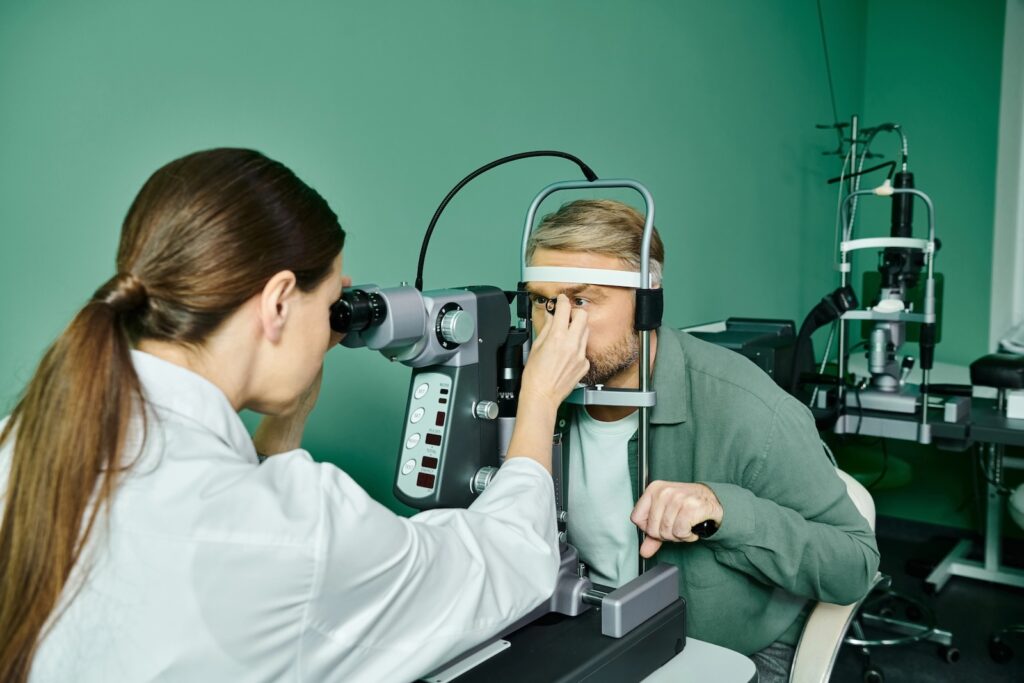
IVOM diagnosis is the crucial diagnostic process that can ultimately lead to the recommendation of IVOM therapy (eye injections). It is not a disease in its own right, but the careful, step-by-step path of clarification that we, as your ophthalmology specialist, take to find the cause of your visual complaints. At our ophthalmology practice in Frankfurt Westend, the precise IVOM diagnosis the indispensable basis for any treatment decision. Dr. Mareen Schmidt uses state-of-the-art technology and her many years of experience as a retina specialist to ensure that IVOM therapy is only recommended if it is absolutely medically necessary and the best option for preserving your vision.
IVOM diagnosis: When is an eye injection the right treatment?
One IVOM diagnosis is made at the end of an examination process if one of several serious retinal diseases is present. The common denominator of these diseases is almost always the presence of fluid in or under the macula, the area of sharpest vision. This swelling (edema) is caused by leaking or abnormally growing blood vessels and leads to the typical symptoms such as distorted vision or a dark spot in the center.
The most common diseases that lead to a positive IVOM diagnosis are
- Wet age-related macular degeneration (AMD): The most common indication.
- Diabetic macular edema (DME): A serious complication of diabetes in the eye.
- Macular edema after retinal vein occlusion: A consequence of a „thrombosis“ in the eye.
- Inflammation inside the eye (uveitis): If these lead to macular swelling.
The diagnostic path to IVOM: a step-by-step process
The path to secure IVOM diagnosis is a structured process that begins with your descriptions and ends with high-resolution imaging.
- Patient interview (anamnesis): It all starts with you and your symptoms. The sudden appearance of distorted vision („crooked lines“) is the most important alarm signal for us.
- Visual acuity test and Amsler grid test: We measure your visual acuity and use the Amsler grid test to objectively document the extent of your distorted vision.
- Slit lamp examination: We examine your eye under the microscope to rule out other causes.
- Optical coherence tomography (OCT): This is the absolutely crucial examination for the IVOM diagnosis. This non-contact scan creates a micrometer-precise layered image of your macula and makes even the smallest accumulation of fluid visible.
- Fluorescein angiography (if necessary): In unclear cases, this contrast medium examination of the retinal vessels may be necessary in order to localize the exact source of the leaking vessels.
The key examination for IVOM diagnosis: Optical coherence tomography (OCT)
Optical coherence tomography, or OCT for short, is at the heart of modern IVOM diagnosis. It can be thought of as an „ultrasound with light“ that allows us to view a high-resolution cross-section of your retina without touching your eye. OCT allows us to assess the individual retinal layers and answer the crucial question: Is the macula „dry“ or „wet“? The presence of intra- or subretinal fluid is the objective evidence of an active disease requiring treatment and therefore the most important finding that determines the IVOM diagnosis and confirmed the need for therapy.
IVOM diagnosis in various diseases: A comparative overview
Although the outcome - fluid in the macula - is often similar, the underlying causes and the specific OCT findings that lead to the IVOM diagnosis vary depending on the disease. The following table gives you a simplified overview.
Disease | Typical symptom that leads to examination | Decisive OCT findings for IVOM diagnosis |
Moist AMD | Sudden distortion of vision in an elderly patient. | Fluid under and/or in the retina, often in conjunction with a visible abnormal vascular membrane. |
Diabetic macular edema | Slowly increasing, foggy or blurred vision in a known diabetic. | Diffuse thickening of the macula with cystoid (vesicular) fluid inclusions. |
Vein occlusion | Sudden, painless loss of vision or a shadow in part of the visual field. | Pronounced swelling of the macula with fluid and often visible hemorrhages in the retinal layers. |
Careful IVOM diagnosis: the importance of the 5-S method
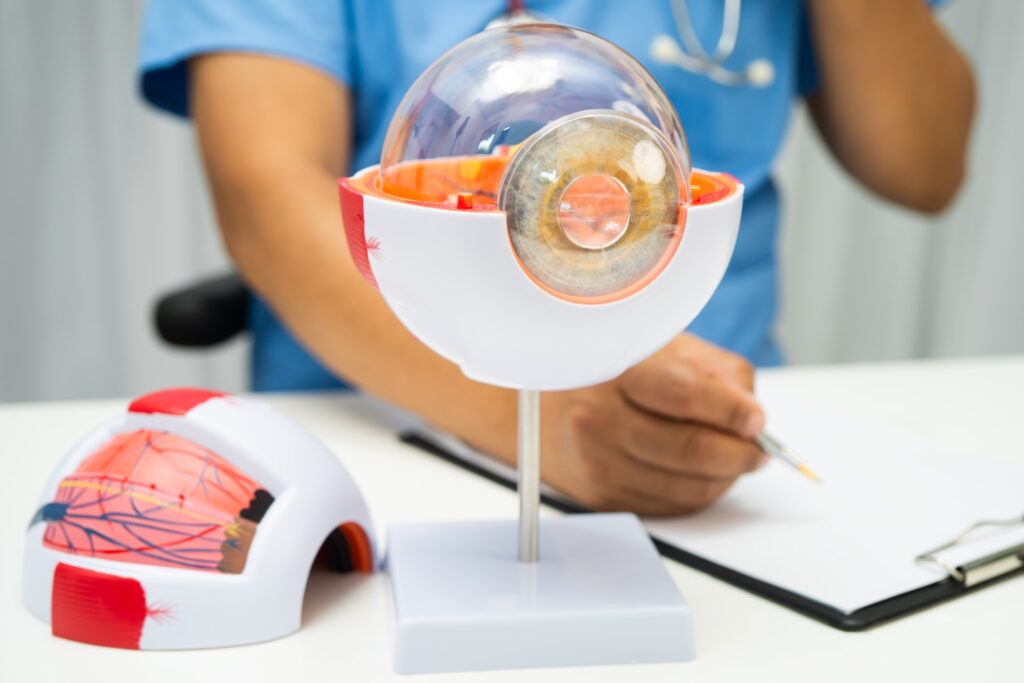
One IVOM diagnosis is a far-reaching decision. That is why we apply the principles of our 5-S method at every step of the diagnostic process. Care„ in particular plays a decisive role here: we take the time to carry out a complete examination and provide clear information. For us, “safety„ means that we take a IVOM diagnosis only make a diagnosis and recommend treatment if the indication is clear and scientifically sound and all other options have been carefully weighed up.
Frequently asked questions about IVOM diagnosis
Here you will find answers to common questions that patients ask us in connection with the IVOM diagnosis in our Frankfurt practice.
Does the ophthalmologist make an IVOM diagnosis immediately at the first visit?
If the symptoms are typical and the findings on OCT are clear, the IVOM diagnosis can often be asked directly at the first appointment. The first treatment can then be planned very promptly. This is particularly important, as these diseases often require urgent treatment in order to preserve vision in the best possible way.
Is the examination for an IVOM diagnosis painful?
No, the entire diagnostic process is painless. The most important examination, OCT, is completely non-contact and only takes a few seconds. If fluorescein angiography is necessary, only a small prick in the arm vein is required to administer the dye, but this is easily tolerated and does not cause any pain. IVOM diagnosis safeguards. As a dye is injected, please let us know if you have any allergies.
What happens if the IVOM diagnosis is unclear?
In rare cases, the findings may not be clear. It is then the task of an experienced retinal specialist to initiate further diagnostic steps or to check the findings at short intervals. A hasty IVOM diagnosis without a reliable basis does not correspond to our careful approach; we only initiate treatment if there is a clear indication.
Why are regular check-ups after an IVOM diagnosis so important?
The diseases that require IVOM therapy are chronic. After the initial IVOM diagnosis and the start of treatment, regular checks with OCT are essential. This is the only way we can objectively assess the success of the therapy and adapt the treatment intervals individually to the disease activity in order to protect your vision in the long term.
Is there anything I can do to prevent a positive IVOM diagnosis?
You can reduce the risk of retinal diseases by adopting a healthy lifestyle: not smoking, a healthy diet and good control of blood pressure and blood sugar are crucial. However, when the first symptoms such as distorted vision appear, it is important to see a doctor quickly to clarify a possible retinal disease. IVOM diagnosis the most important step you can take yourself. Do not hesitate.
Can the IVOM diagnosis also be wrong?
The interpretation of OCT images requires a great deal of experience. A retinal specialist such as Dr. Mareen Schmidt can identify the typical signs that lead to a IVOM diagnosis very reliably from other, harmless changes. However, a second opinion from a specialist can be useful in cases of uncertainty and is supported by us.
What is the difference between the diagnosis of dry and wet AMD?
The decisive difference, which is discussed in the IVOM diagnosis is the detection of fluid in the OCT. In dry AMD, we see deposits (drusen) and slow cell death, but no fluid. Only the detection of fluid leads to the diagnosis of wet AMD and the need for IVOM therapy.
Does my diabetes automatically mean a future IVOM diagnosis?
No, not necessarily. Good blood sugar control and regular ophthalmologic check-ups are the best precautionary measures to prevent serious retinal changes. However, if macular oedema does develop, early IVOM diagnosis timely treatment before serious damage occurs. An annual check-up is therefore mandatory for every diabetic.
What is the Amsler grid test used for in IVOM diagnosis?
The Amsler grid test is a simple self-test that helps you to recognize the first symptoms that could lead to a IVOM diagnosis early on. If you look at the grid and the lines suddenly appear wavy, distorted or broken, this is an important alarm signal that requires an immediate ophthalmologic examination. This test is an important tool for early detection.
Why should I go to a specialist for an IVOM diagnosis?
The interpretation of modern imaging procedures and the decision for or against IVOM therapy require the highest level of expertise. A retina specialist like Dr. Mareen Schmidt has the necessary experience and technical equipment to make a safe decision. IVOM diagnosis and to optimally manage the subsequent, often long-term treatment. Your vision should be in the hands of an expert.
A precise diagnosis is the first step towards recovery
The IVOM diagnosis is the beginning of a path that we will walk together with you. It is the basis on which we can build an effective and sight-preserving therapy. If you suffer from symptoms such as distorted vision or sudden visual deterioration, don't hesitate. Make an appointment at our Frankfurt practice for a comprehensive and thorough diagnostic assessment by Dr. Mareen Schmidt.