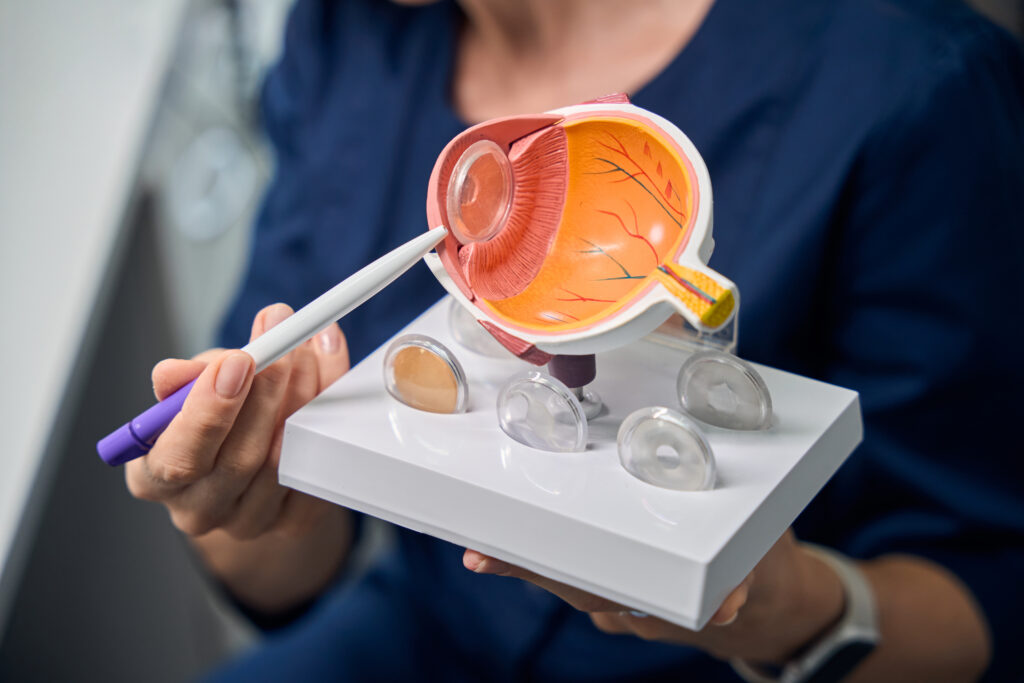
Retinal screening for high myopia is one of the most important specialized examinations in ophthalmology, designed to detect and minimize the risk of serious, vision-threatening complications early on. People with high myopia have an anatomically higher risk of developing diseases of the back of the eye. At our ophthalmology practice in Frankfurt Westend, Dr. Mareen Schmidt, an experienced retinal specialist, focuses on providing you with precise and thorough care. Retinal screening for high myopia To give your eyes the security they deserve.
Why is retinal screening so important for people with high myopia?
In nearsighted eyes, the eyeball is "too long" compared to a normally sighted eye. The higher the degree of nearsightedness, the longer the eyeball. You can imagine it like inflating a balloon: the outer layer stretches everywhere, becoming thinner and more fragile. This is exactly what happens to the retina. This constant stretching leads to a thinning of the retina, especially in the outer (peripheral) areas. These thin areas are weak points and significantly more prone to developing defects such as holes or tears. Regular eye exams are essential to prevent this. Retinal screening for high myopia is therefore essential in order to detect these potential precursors of retinal detachment in time.
The main risks associated with high myopia are:
- Retinal holes and tears: The traction of the vitreous humor can cause defects in the thin areas of the retina.
- Retinal detachment (Ablatio retinae): Fluid from the vitreous humor can leak through a hole or tear under the retina, detaching it from its underlying tissue. This is an ophthalmological emergency that often requires major surgery and can lead to permanent vision loss.
- Myopic maculopathy: The stretching can also damage the macula, the area of sharpest vision, and lead to a slow but irreversible loss of central vision.
Retinal screening for high myopia: Our diagnostic procedure
A comprehensive Retinal screening for high myopia In our Frankfurt practice, we offer a structured, painless process designed to obtain a complete and detailed picture of your entire retina. Our procedure:
- Medical history: We will ask about your exact diopter strength, any family history of the condition, and whether you have noticed any symptoms such as flashing lights or "flying flies".
- Examination of the fundus: This is the crucial step. To be able to fully assess the retina, right to the outermost periphery, pupil dilation with medication is usually necessary. Only then can Dr. Mareen Schmidt reliably detect even the smallest defects using a special magnifying lens on the slit-lamp microscope.
- Modern wide-angle photography: In many cases, we also use our modern wide-angle scanning technology. This creates a high-resolution panoramic image of your retina, enabling excellent documentation and precise comparison during future checkups.
- Optical coherence tomography (OCT): In cases of changes in the macula, we use this high-resolution scan to create a micrometer-precise layered image in order to assess the condition of the central photoreceptor cells.
What happens if something is found during the examination?
Should we be involved in your Retinal screening for high myopia If a change requiring treatment, such as a retinal hole, is detected, this is no reason to panic, but rather a great opportunity to prevent retinal detachment. In such a case, the defect can usually be sealed with a short, outpatient, and painless laser treatment (argon laser coagulation). The laser creates precisely targeted small scars around the hole, thus reattaching the retina firmly to its underlying tissue. This preventative treatment is one of the most important measures that can prevent retinal detachment. Retinal screening for high myopia that makes it so valuable.
Risks associated with high myopia: An overview
The following table gives you an overview of the most important risks we should be aware of when... Retinal screening for high myopia regard.
|
Disease / Finding |
Typical symptoms |
The aim of the preventive examination |
|
Peripheral retinal degeneration („thin spot“) |
Usually no symptoms. |
Identification of risk areas, determination of control intervals. |
|
Retinal hole/tear |
Often, sudden flashes of light and/or "soot rain" occur. |
Early detection and preventive laser treatment to prevent retinal detachment. |
|
Retinal detachment |
Perception of a dark shadow or "curtain" that does not move. |
It's already an emergency. Preventive measures are intended to detect the early stages. |
|
Myopic maculopathy |
Slowly increasing distorted vision, decrease in central visual acuity. |
Early detection and documentation of the course using OCT. |

Frequently asked questions about retinal screening in high myopia
Here you will find answers to frequently asked questions that we, as patients, receive during the course of treatment. Retinal screening for high myopia in our Frankfurt practice.
At what diopter level is someone considered "severely nearsighted"?
Generally, nearsightedness of -5 to -6 diopters is considered high myopia. Above this level, the risk of retinal changes increases significantly, and regular eye exams are recommended. Retinal screening for high myopia It is strongly recommended. Regardless of the exact diopter value, an annual check-up is advisable for any form of progressive myopia.
How often should I come for retinal screening if I have high myopia?
For patients with high myopia, we generally recommend an annual Retinal screening for high myopia. If thinning areas or other risk factors are already known, shorter check-up intervals of six months may be necessary. Dr. Mareen Schmidt will make a clear recommendation based on your individual findings.
Does my pupil always need to be dilated for the examination?
For a complete and comprehensive assessment of the outermost retinal periphery, pharmacological pupil dilation is the gold standard in the Retinal screening for high myopia. Our modern wide-angle photography can provide an excellent overview, but in this particular case it does not always replace the direct, three-dimensional view of the doctor with a magnifying glass right up to the edge of the retina.
I saw lightning. Do I need to come immediately?
Yes, the sudden appearance of flashing lights, especially if it occurs repeatedly and always in the same area of the field of vision, is a warning sign. It can be caused by the vitreous humor pulling on the retina and may indicate the formation of a tear. This is an urgent case requiring medical attention. Retinal screening for high myopia and should not be postponed.
Will my health insurance cover the costs of preventative care?
The Retinal screening for high myopia Fundus examination is considered a medically necessary examination to assess an increased risk of serious eye disease. Therefore, the costs for examining the fundus with dilated pupils are generally covered by all statutory and private health insurance companies. Modern additional examinations, such as wide-angle photography, are often considered individual health services (IGeL).
Can I reliably prevent a retinal detachment through preventative measures?
There is never 100% security. Regular... Retinal screening for high myopia However, it is by far the most effective method to drastically reduce the risk of retinal detachment. By detecting precursors such as holes or tears early and treating them with a laser, we can prevent a detachment from occurring in the vast majority of cases.
I wear contact lenses. Does that affect my risk?
Wearing contact lenses itself has no direct influence on the risk of retinal changes. However, since contact lens wearers are by definition nearsighted, the risk of retinal changes is higher for them. Retinal screening for high myopia Just as important as for eyeglass wearers with the same diopter values. Regular eye examinations are essential for every nearsighted person.
What can I do myself to protect my retina?
The most important contribution you can make is to regularly attend your appointments. Retinal screening for high myopia. Furthermore, pay attention to warning signs such as flashes of light, floaters, or a shadow in your field of vision and consult an ophthalmologist immediately if you experience any of these. Otherwise, there are no specific lifestyle measures that can reduce the anatomical risk associated with retinal degeneration.
Is laser treatment to close a hole painful?
No, laser treatment is generally not painful. The eye is prepared with numbing eye drops before the treatment. You sit comfortably at the laser device and may feel a slight tingling sensation or see bright flashes of light. The procedure is part of the Retinal screening for high myopia It is short and very safe.
Why is a retina specialist like Dr. Mareen Schmidt important?
As a retina specialist, Dr. Mareen Schmidt has particular expertise in examining the peripheral retina and performing laser treatments. She can reliably distinguish between harmless changes and defects requiring treatment and can make well-founded determinations regarding the need for preventive laser therapy. This expertise is the key to high-quality care. Retinal screening for high myopia.
Play it safe – protect your retina
As a person with severe myopia, you bear a special responsibility for your eye health. Regular eye exams are essential. Retinal screening for high myopia It's a simple, painless, yet potentially vision-preserving procedure. Don't hesitate and take this important examination seriously. Feel free to schedule an appointment for your comprehensive and thorough preventative eye exam at our Frankfurt practice.