Rare retinal diseases present a particular challenge for both patients and doctors. Diagnosis is often a long, detective-like process, and the uncertainty can be very stressful. At our ophthalmology practice in Frankfurt Westend, Dr. Mareen Schmidt, an experienced retinal specialist, focuses on providing a competent point of contact for patients with unclear or rare findings in the fundus. We take the time for in-depth diagnostics to provide you with a clear diagnosis and a well-founded treatment strategy based on the latest scientific findings. rare retinal disease to provide guidance.
Rare retinal diseases: The diagnostic challenge
What does the diagnosis and care involve in rare retinal diseases So demanding? Several factors require the expertise of a specialist:
- Nonspecific symptoms: Many rare retinal diseases They begin with nonspecific symptoms such as a slow deterioration of vision, problems in twilight, or altered color perception, which can easily be mistaken for more common diseases.
- Complex findings: Changes in the retina are often subtle and require a trained eye and state-of-the-art imaging techniques to interpret them correctly.
- Interdisciplinary connections: Many rare retinal diseases are part of a systemic disease that affects the whole body and require close collaboration with other specialists such as rheumatologists, neurologists or human geneticists.
- Need for special diagnostics: Standard examinations are often insufficient.1 Specialized diagnostic tests such as electroretinography (ERG) or genetic analysis are necessary to confirm the diagnosis.
Examples of rare retinal diseases: A brief overview
The spectrum of rare retinal diseases The range of conditions is broad and diverse. Most of these disorders are genetic and are referred to as retinal dystrophies. The following table provides a brief overview of some of these conditions that we diagnose and treat in our Frankfurt practice.
Disease | Key Feature | Typical symptoms |
Retinitis Pigmentosa (RP) | Progressive degeneration of the rod photoreceptors (for night vision). | Night blindness, increasing narrowing of the visual field ("tunnel vision"). |
Stargardt disease | A genetically determined disease that leads to early cell death in the macula. | Decline in central visual acuity, usually beginning in childhood or adolescence. |
Best disease (vitelliform macular dystrophy) | Genetic defect that leads to an egg yolk-like (vitelliform) deposit under the macula. | Eyesight can remain good for a long time, but there is a risk of sudden vision deterioration. |
Cone-rod dystrophy | Progressive degeneration of the cone photoreceptors (for color and day vision) and later the rod photoreceptors. | Severe glare sensitivity, loss of color vision, decrease in central visual acuity. |
Birdshot chorioretinopathy | Chronic, autoimmune inflammation of the choroid and retina, often with characteristic bright spots. | Blurred vision, perception of "flying flies", glare, night blindness. |
Diagnosis of rare retinal diseases: State-of-the-art technology in use
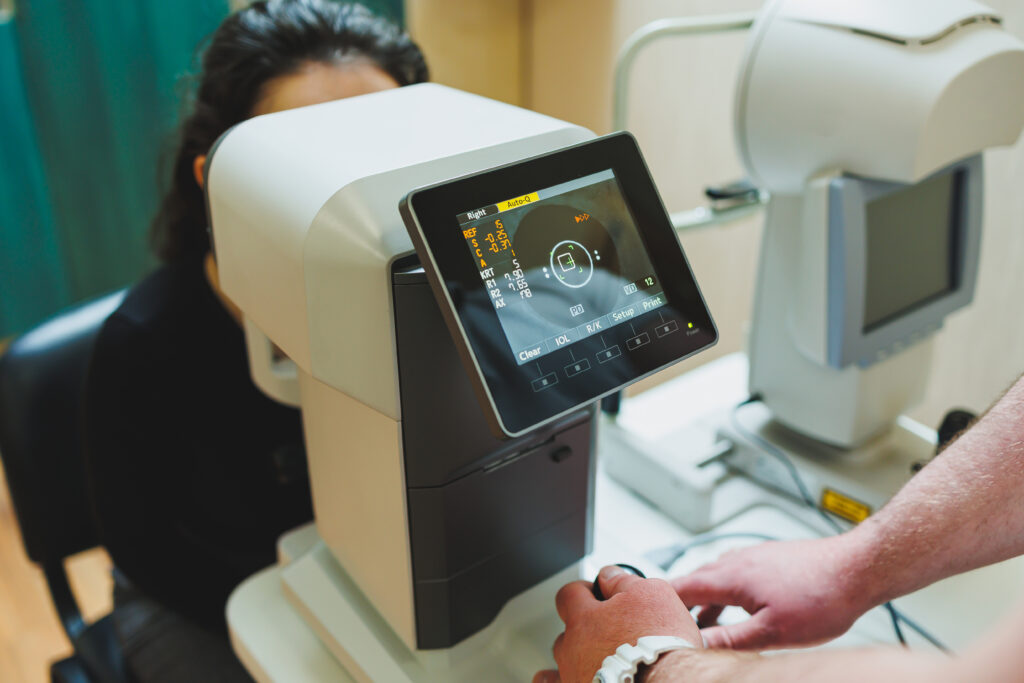
To obtain a reliable diagnosis in case of suspected a rare retinal disease To diagnose the condition, comprehensive and often highly specialized diagnostics are required. In our practice, we use state-of-the-art technologies for this purpose.
- Optical coherence tomography (OCT): This high-resolution layer imaging technique is essential for assessing the fine structures of the retina and visualizing typical changes such as the destruction of cell layers or fluid accumulation.
- Wide-angle fundus photography & autofluorescence: These imaging techniques allow for detailed documentation of the entire fundus and can visualize pathological metabolic processes in the retina.
- Electrophysiology (ERG/EOG): These examinations, similar to an ECG of the heart, measure the electrical responses of the photoreceptor cells to light stimuli. They are crucial for objectively assessing retinal function and differentiating between various dystrophies. We will refer you to specialized centers for this examination.
- Visual field examination (perimetry): This allows us to precisely measure typical visual field defects, such as the "tunnel vision" in retinitis pigmentosa.
- Genetic diagnostics: In many rare retinal diseases A blood test for genetic analysis can confirm the diagnosis and provide important information for prognosis and family planning.
Treatment of rare retinal diseases: What is possible today?
The treatment strategy for rare retinal diseases Communication must be realistic and honest. For many genetically determined retinal dystrophies, there is currently no cure. Treatment therefore focuses on several key areas:
- Slowing of progression: In some diseases, light protection (edge filter lenses) or the intake of certain vitamins can slow the progression.
- Treatment of complications: Many rare retinal diseases These complications can lead to complications such as macular edema (swelling) or cataracts. We can effectively treat these complications, for example with IVOM therapy (intravitreal injections) or cataract surgery.
- Provision of visual aids: The fitting of magnifying visual aids (magnifying glasses, screen readers) is crucial to make optimal use of remaining eyesight and to maintain quality of life.
- Participation in studies: As a specialized practice, we are informed about current research approaches and clinical trials and can advise you on whether participation is suitable for you. Research in the field of gene therapy is making great strides and gives cause for hope.
Frequently asked questions about rare retinal diseases
Here you will find answers to frequently asked questions that we patients have in connection with rare retinal diseases in our Frankfurt practice.
What exactly makes a retinal disease a "rare" disease?
In Europe, a disease is considered rare if it affects no more than 5 in 10,000 people. Many rare retinal diseases are even rarer. This low frequency is the reason why diagnosis is often difficult and requires the expertise of a specialist familiar with the clinical pictures.
Are rare retinal diseases always hereditary?
The majority of rare retinal diseases, Retinal dystrophies, particularly retinitis pigmentosa or Stargardt disease, are genetically determined. However, there are also rare inflammatory or autoimmune diseases that are not directly inherited. Accurate diagnosis and, if necessary, genetic counseling are crucial to clarify the cause and determine the risk of recurrence within the family.
Is there anything I can do myself to prevent a rare retinal disease?
Since most rare retinal diseases Since these conditions are genetically determined, there is no effective prevention in the classical sense. The most important thing you can do is to consult a specialist at the first sign of vision problems (especially night blindness or glare sensitivity). Consistent UV protection of the eyes with good sunglasses is a sensible general protective measure for the retina.4
What is an electroretinogram (ERG)?
The ERG is a crucial test for diagnosing... rare retinal diseases. After the eye has adapted to darkness, the electrical activity of the entire retina is measured in response to standardized flashes of light. Based on the recorded curves, the specialist can determine precisely whether the rod cells, the cone cells, or both are affected, which is crucial for diagnosis.
What does a genetic test mean for me and my family?
A genetic test can be helpful in many cases. rare retinal diseases Confirming the clinical diagnosis and identifying the precise genetic defect can provide important information about the expected course of the disease and is a prerequisite for participation in future gene therapy trials. It also enables targeted testing and counseling of family members.
Why is a retina specialist like Dr. Mareen Schmidt so important?
The care of patients with rare retinal diseases It requires more than just medical knowledge. It requires experience with often atypical findings, access to a network of specialists, and the ability to provide empathetic support to patients and their families over many years. As an experienced retinal specialist, Dr. Mareen Schmidt offers you this comprehensive and personalized care.
Are there support groups for rare retinal diseases?
Yes, connecting with other affected individuals is extremely important for support. Organizations like PRO RETINA Deutschland e.V. offer an excellent platform for exchange, advice, and information about the latest research on this condition. rare retinal diseases. We actively encourage our patients to use these services.
Can I still drive a car if I have a rare retinal disease?
That depends heavily on the type and stage of the disease. rare retinal diseases, In cases of severe visual field narrowing (as in retinitis pigmentosa) or a significant reduction in central visual acuity, driving ability is often no longer present. An honest and official assessment of your fitness to drive is an important and responsible part of our consultation.
What are edge filter glasses and can they help me?
Edge filter lenses are special spectacle lenses with a defined color filter (usually yellow, orange, or red). They are available for many prescriptions. rare retinal diseases, These lenses, which are associated with increased glare sensitivity and reduced contrast sensitivity, significantly improve visual acuity and comfort. We would be happy to advise you on whether such lenses would be a beneficial option for you.
Is there hope for a cure in the future?
Yes, research in the field of rare retinal diseases It is making enormous progress. Gene therapy, in particular, has already yielded the first approved treatments for a few diseases. It is a long road, but scientific developments give rise to justified hope that effective therapies will be available for more and more of these diseases in the future.
A partner at your side in dealing with rare retinal diseases
The diagnosis of rare retinal disease This is a profound life-changing event. That's why it's so important to have a competent and empathetic partner by your side who guides you through the diagnostic process, explains all your options, and provides long-term support. If you suspect you may have a rare disease or would like a qualified second opinion, please feel free to schedule an appointment for a comprehensive and personal consultation with Dr. Mareen Schmidt at our Frankfurt practice.