The risk of retinal detachment is one of the biggest concerns in ophthalmology, as it is an acute emergency that can lead to blindness if left untreated. The good news, however, is that in most cases, retinal detachment is preceded by precursor conditions that can be detected and treated with timely examination. At the ophthalmology practice of Dr. Mareen Schmidt in Frankfurt Westend, we, as retinal specialists, are focused on your individual needs. Risk of retinal detachment to assess precisely and to take the necessary steps to protect your eyesight through careful preventative measures.
What is a retinal detachment and why is it an emergency?
The retina is the light-sensitive layer that lines the back of the eye, similar to the film in a camera. It is responsible for converting light into nerve impulses. In a retinal detachment, this layer separates from its supporting layer, the choroid. As a result, the light-sensitive photoreceptor cells are no longer supplied with oxygen and nutrients and die within a short time. Risk of retinal detachment The danger lies in the fact that this process leads to permanent and irreversible vision loss in the affected areas. Once damage has occurred, it cannot be repaired, which is why prompt action at the first signs is crucial.
The risk of retinal detachment: Who is particularly at risk?
The Risk of retinal detachment The risk is not the same for everyone. Certain risk factors significantly increase the likelihood of developing retinal defects and subsequent detachment. Understanding these factors is the first step towards targeted and effective preventative care.
The most important risk groups include:
- People with severe myopia (high myopia): This is the most important risk factor. In nearsighted eyes, the eyeball is longer, which leads to stretching and thinning of the retina, especially in the outer (peripheral) areas.
- People after cataract surgery (cataract): The operation can alter the stability of the vitreous humor, which can... Risk of retinal detachment Slightly increased in the months and years following the procedure.
- Patients with a family history of the condition: If close relatives have already suffered a retinal detachment, one's own risk may also be increased.
- People after an eye injury: A severe blow or contusion of the eye (eyeball contusion) can lead to tears in the retina.
- Patients with certain retinal diseases: Certain congenital weaknesses in the retina ("grid line degeneration") also increase the risk.
Risk of retinal detachment: Recognizing the crucial warning signs
The insidious thing is that the precursors of a retinal detachment, such as holes or tears, often cause no pain. However, they announce themselves through typical, sudden symptoms caused by the vitreous humor pulling on the retina. If you notice any of these warning signs, you must consider it an absolute emergency and see an ophthalmologist or eye clinic immediately. Prompt diagnosis is key to preventing the detachment. Risk of retinal detachment to minimize.
Pay attention to these three classic warning signs:
- Flashes of light: They repeatedly perceive short, bright flashes of light, mostly in the periphery of their vision and even with their eyes closed.
- „Soot rain“: You suddenly see a multitude of small, black, moving dots or threads, as if someone had scattered soot or a handful of mosquitoes into your field of vision. This can be a sign of minor bleeding from a torn retinal blood vessel.
- Dark shadow or "curtain": You notice a stationary, dark shadow that slowly moves into your field of vision from one side (often from below or from the side) and remains there. This is the classic symptom of an already initiated retinal detachment.
The examination: How we assess your personal risk of retinal detachment
To create your individual Risk of retinal detachment To make a precise assessment, a thorough examination of the entire fundus, extending to the outermost periphery, is necessary. In our Frankfurt practice, we dedicate the required time to this examination and apply the principles of our 5-S method.
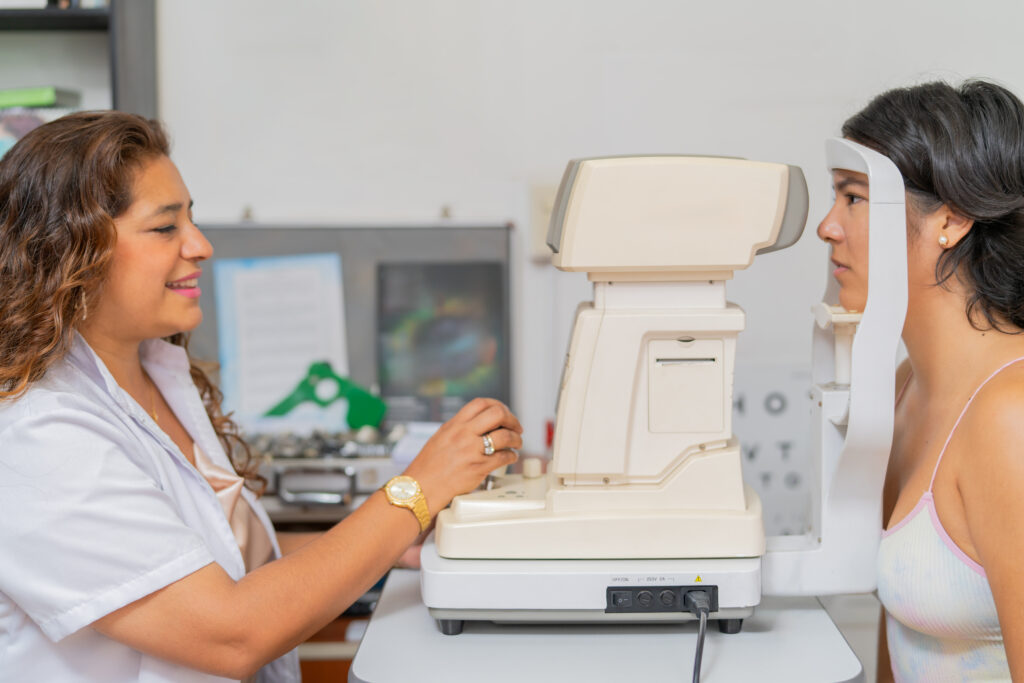
After a thorough medical history, the crucial step is the examination using a slit-lamp microscope with medicated dilation of the pupil. Only through dilation can Dr. Mareen Schmidt use a special magnifying lens to examine the entire retina and search for potential weaknesses, tears, or holes. Modern wide-angle photography can also be helpful for precise documentation of the findings. This meticulous approach ensures that we can accurately assess your condition. Risk of retinal detachment be able to make a sound judgment.
Minimizing the risk of retinal detachment: Preventive laser treatment
Should we detect a precursor, such as a retinal hole or tear, during the examination, this is not a cause for panic, but rather a great opportunity to prevent a detachment. In such a case, preventive laser treatment (argon laser coagulation) is the therapy of choice to prevent the detachment. Risk of retinal detachment to drastically reduce the risk. In this short, outpatient, and painless procedure, a laser is used to create precisely targeted tiny "welding points" around the defect. The resulting scars firmly reattach the retina to its underlying tissue and prevent fluid from seeping under the retina.
Warning symptoms and recommended actions at a glance
Symptom | Possible cause | Recommendation for Action |
Slowly increasing „flying midges“ (Mouches volantes) | Normal vitreous changes | Regular eye exams are recommended, but it's usually not an emergency. |
Sudden appearance of flashing lights and/or "soot rain"„ | Vitreous detachment with possible retinal tear | Urgent emergency! Immediate consultation with an ophthalmologist or at an eye clinic (even on weekends). |
Immobile, dark shadow ("curtain") | Already begun retinal detachment | Absolute emergency! Immediate consultation at an eye clinic is necessary, as surgery is often unavoidable. |
Frequently asked questions about the risk of retinal detachment
Here you will find answers to common questions that patients ask us about Risk of retinal detachment in our Frankfurt practice.
Can the risk of retinal detachment also be hereditary?
Yes, that Risk of retinal detachment Retinal detachment can occur more frequently in families. If your parents or siblings have already suffered a retinal detachment, your personal risk is statistically increased. In this case, regular preventive examinations are recommended to assess your individual risk. Risk of retinal detachment This is especially important to protect the health of your eyes.
Does sport or physical exertion increase the risk of retinal detachment?
In a healthy eye without pre-existing conditions, normal sporting activity increases the Risk of retinal detachment No. However, patients with known risk factors such as high myopia or pre-existing retinal weaknesses should avoid sports involving strong impacts or a high risk of head injuries (e.g., boxing, bungee jumping). Individual consultation with your ophthalmologist is crucial in these cases.
Are "flying midges" always a sign of increased risk?
The perception of individual dots or threads slowly moving across the field of vision is usually harmless and due to normal vitreous opacities. They increase the Risk of retinal detachment Not directly. However, a warning sign is the sudden, massive appearance of many small spots ("soot rain"), as this can indicate bleeding, which the Risk of retinal detachment increased.
How exactly does high myopia increase the risk of retinal detachment?
In high myopia, the eyeball is longer than normal. This stretching causes the retina to become thinner and more fragile, especially in the outer areas. It is in these thin areas that the Risk of retinal detachment The risk is significantly increased, as cracks or holes can develop more easily. That's why annual eye exams are so important for people with severe myopia to monitor their eye health. Risk of retinal detachment to monitor.
Is preventive laser treatment painful?
No, laser treatment to close a retinal hole is usually not painful. The eye is prepared with numbing eye drops before the procedure. You sit comfortably at the laser device and may feel a slight tingling sensation or see bright flashes of light. The procedure to lower the Risk of retinal detachment It is short and very safe.
What happens if I ignore the warning symptoms?
If you ignore typical warning signs such as lightning and soot rain, you are taking an extremely high risk. Risk of retinal detachment Acceptable risk. A treatable tear can develop into a complete detachment within hours or days. This then requires major surgery in a hospital, and the prognosis for preserving eyesight is significantly worse than if preventative measures had been taken.
Can a retinal detachment occur in both eyes?
Yes, unfortunately that's possible. If you've suffered a retinal detachment in one eye, that's... Risk of retinal detachment The risk is also statistically significantly increased in the other eye. In this case, lifelong, regular checkups of both eyes are essential to protect the health of the second eye and prevent further damage. Risk of retinal detachment to minimize.
Does cataract surgery increase the risk of retinal detachment?
Yes, statistically speaking, that's correct. Risk of retinal detachment The risk of retinopathy of prematurity (ROP) is slightly elevated after cataract surgery. This is because the procedure can alter the stability of the vitreous humor. Therefore, a thorough examination of the retinal periphery before and after cataract surgery is an important part of medical care to ensure the risk of ROP. Risk of retinal detachment to be able to assess correctly.
How often should I have my risk of retinal detachment checked?
If you belong to a risk group (especially high myopia), we recommend an annual retinal examination with dilated pupils. This is the only way we can accurately assess your individual retinal health. Risk of retinal detachment Assess accurately and detect changes early. Of course, you must come in immediately if new symptoms occur.
Why should I go to a retina specialist for this examination?
Assessing the peripheral retina requires extensive experience and specialized examination techniques. As a retinal specialist, Dr. Mareen Schmidt possesses the necessary expertise to reliably detect even subtle changes and differentiate between harmless findings and those requiring treatment. This experience is crucial for your Risk of retinal detachment to assess correctly and make the right therapy decision.
Act immediately at warning signs – your eyesight is worth it.
The Risk of retinal detachment It is real, but manageable through knowledge, awareness, and regular preventative care. Never hesitate to seek immediate medical attention if you experience any of the warning symptoms mentioned. If you belong to a risk group, please feel free to schedule an appointment for a comprehensive and thorough preventative examination at our Frankfurt practice to determine your personal risk.