
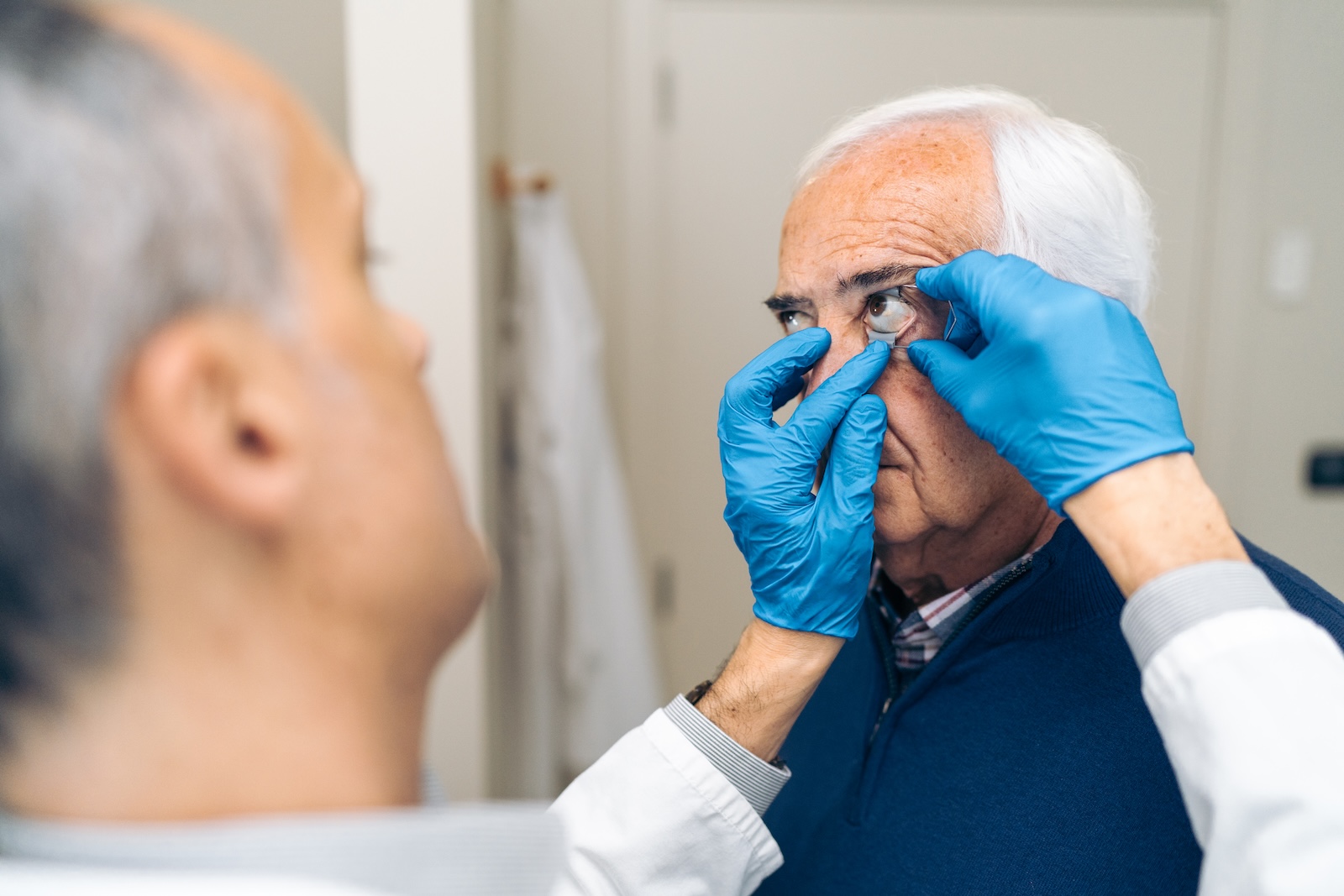
The Glaucoma is an insidious, often painless disease which, if left untreated, can lead to irreversible blindness can lead. The Glaucoma screening in our Frankfurt practice is therefore one of the most important preventive measures to protect your eyesight. Dr. med. Mareen Schmidt in Westend relies on State-of-the-art, gentle diagnostics, this insidious disease to recognize at an early stage and secure your eyesight in the long term.
Glaucoma is not a single disease, but a group of eye diseases that have one thing in common: They lead to progressive and irreversible damage to the optic nerve. The optic nerve is the „data cable“ that transmits all visual impressions from the eye to the brain. If the millions of nerve fibers that make it up are damaged, gaps occur in the visual field. As these losses typically begin at the edge of the visual field and central vision remains intact for a long time, those affected often only notice the disease at a very late stage. An effective Glaucoma screening is therefore the only way to stop this „silent thief of sight“ in time.
Comprehensive glaucoma screening in our Frankfurt practice goes far beyond a simple measurement. It consists of several complementary components, which together provide a precise picture of the health of your optic nerve and your individual risk.
Intraocular pressure measurement (tonometry): Elevated intraocular pressure is the most important risk factor for the development of glaucoma. We carry out this measurement gently and contact-free, without having to touch your eye directly. Our devices are FDA-approved.
Assessment of the optic nerve head (ophthalmoscopy): Dr. Mareen Schmidt uses a special microscope to examine the optic nerve head, the point at which the optic nerve exits the eye. Typical glaucoma changes, such as an increasing hollowing („excavation“), can be detected here at an early stage.
Corneal thickness measurement (pachymetry): The thickness of your cornea has an influence on the accuracy of the intraocular pressure measurement. By measuring the corneal thickness, we can individually correct the measured pressure value and assess it even more precisely.
Papillary OCT and OCT-A (optical coherence tomography and angiography): These high-resolution, non-invasive imaging techniques allow precise measurement of the nerve fiber layer at the optic nerve head (optic disc) and in the area of the macula. The Papilla OCT detects even the finest, early nerve fiber loss before it becomes visible in the visual field or during ophthalmoscopy. The OCT-A provides additional information about the blood supply to the optic nerve.
Visual field examination (perimetry): This functional examination measures whether there are already losses in your peripheral or central vision. As glaucoma damage often occurs late in the visual field, this examination is used to document and monitor the progression of advanced disease.
Interdisciplinary approach with internists for normal pressure glaucoma: In patients with normal pressure glaucoma, where the intraocular pressure is not elevated, vascular or systemic causes (e.g. blood pressure fluctuations, circulatory disorders) may play a role. In these cases, we work closely with experienced internists to identify and treat risk factors outside the eye.
Although a Glaucoma screening is generally recommended for every adult over the age of 40, there are certain risk groups for whom earlier and more regular check-ups are particularly important.
The optic nerve is more susceptible to pressure damage in very short-sighted eyes.
The risk increases significantly from the age of 40.
The main risk factor.
If your parents or siblings have glaucoma, your personal risk is significantly increased.
The following table gives you an overview of the most important procedures and their respective contribution to the diagnosis.
Procedure | What is measured/assessed? | Why is it important for glaucoma screening? |
Tonometry | Der Augeninnendruck. | Identifiziert den wichtigsten behandelbaren Risikofaktor. |
Ophthalmoskopie | Das Aussehen und die Form des Sehnervenkopfes. | Ermöglicht die direkte visuelle Erkennung von typischen Glaukomschäden. |
Pachymetrie | Die Dicke der Hornhaut. | Erhöht die Genauigkeit der Augeninnendruckmessung. |
OCT des Sehnervs | Die exakte Dicke der Nervenfaserschicht. | Erkennt früheste, strukturelle Schäden oft Jahre vor anderen Tests und ermöglicht eine präzise Verlaufsbeobachtung. |
Glaucoma screening
Die Glaucoma screening stützt sich auf eine Kombination aus verschiedenen, spezifischen Untersuchungen, die jeweils unterschiedliche, aber wichtige Informationen zur Erkennung und Überwachung der Erkrankung liefern.
Messung und Beurteilung
Die Tonometry dient der Messung des Augeninnendrucks – dem wichtigsten behandelbaren Risikofaktor für das Glaukom. Da ein erhöhter Augeninnendruck zu einer Schädigung des Sehnervs führen kann, ist diese Messung unerlässlich.
Parallel dazu ermöglicht die Ophthalmoskopie dem Augenarzt die direkte visuelle Beurteilung des Aussehens und der Form des Sehnervenkopfes. Diese Untersuchung ist entscheidend, da sie die Erkennung von typischen, bereits bestehenden Glaukomschäden am Nerv ermöglicht.
Die augenärztlichen Fachgesellschaften empfehlen eine regelmäßige Glaucoma screening für alle Menschen ab dem 40. Lebensjahr. Bei Vorliegen von Risikofaktoren, insbesondere einer familiären Belastung, sollte die erste Untersuchung bereits früher stattfinden. Ein frühzeitiger Beginn der Vorsorge ist der beste Schutz.
Nein, keine der Untersuchungen im Rahmen der Glaucoma screening ist schmerzhaft. Die moderne Augeninnendruckmessung erfolgt mit einem sanften Luftstoß und ist berührungslos. Auch die OCT-Untersuchung ist ein reines Scan-Verfahren, bei dem Sie lediglich ein Fixierlicht anblicken. Unsere sanfte Vorgehensweise ist Teil unseres Qualitätsversprechens.
Das empfohlene Intervall für die Glaucoma screening hängt von Ihrem Alter und Ihrem individuellen Risikoprofil ab. Bei unauffälligem Befund und niedrigem Risiko kann ein Intervall von zwei Jahren ausreichend sein. Bei erhöhten Risikofaktoren oder grenzwertigen Befunden sind jährliche Kontrollen sinnvoll, um jede Veränderung frühzeitig zu erfassen.
Ja, das ist ein sehr wichtiger Punkt. Es gibt eine Form des Glaukoms, das sogenannte "Normaldruckglaukom", bei dem der Sehnerv geschädigt wird, obwohl der Augeninnendruck im statistischen Normbereich liegt. Aus diesem Grund ist eine alleinige Druckmessung für eine sichere Glaucoma screening nicht ausreichend. Die Beurteilung des Sehnervs ist immer der entscheidende Faktor.
Ein auffälliger Befund bei der Glaucoma screening ist kein Grund zur Panik, sondern die Chance, rechtzeitig zu handeln. Dr. med. Mareen Schmidt wird den Befund ausführlich mit Ihnen besprechen. In der Regel wird dann eine Gesichtsfelduntersuchung (Perimetrie) durchgeführt, um zu prüfen, ob bereits funktionelle Ausfälle vorliegen. Sollte sich die Diagnose bestätigen, kann durch eine Therapie mit Augentropfen das Fortschreiten der Erkrankung in den allermeisten Fällen gestoppt oder stark verlangsamt werden.
Die wichtigste Maßnahme ist die regelmäßige Teilnahme an der Glaucoma screening, da Sie die Erkrankung selbst nicht spüren können. Ein gesunder Lebensstil mit regelmäßiger Bewegung und einer guten Kontrolle von Blutdruck und Blutzucker kann die Durchblutung des Sehnervs unterstützen. Die Früherkennung beim Augenarzt bleibt jedoch der entscheidende Faktor für den Schutz Ihrer Sehkraft.
Für eine umfassende Beurteilung des Sehnervenkopfes im Rahmen der Glaucoma screening ist eine medikamentöse Erweiterung der Pupille oft von Vorteil. Ob dies bei Ihnen notwendig ist, hängt von Ihrer individuellen Anatomie ab. Dank unserer modernen OCT-Technologie können wir jedoch oft schon ohne Weittropfen eine sehr präzise Analyse der Nervenfaserschicht durchführen.
These two diseases are often confused. Glaucoma, which occurs with the Glaucoma screening is a disease of the optic nerve. A cataract is a clouding of the lens of the eye that leads to blurred vision but can be completely cured by surgery. The damage caused by glaucoma, on the other hand, is irreversible.
In the practice of Dr. med. Mareen Schmidt you benefit from a Glaucoma screening at the highest level. We combine state-of-the-art technology such as optic nerve OCT with the many years of experience of a specialist. Our careful and gentle approach using the 5-S method ensures an examination that is as precise as it is comfortable. Your eyesight is in the best hands with us.
Generally not, you can drive afterwards, go to the office or do sports.


As your Ophthalmologist Frankfurt, Dr. Mareen Schmidt combines many years of clinical experience as a senior physician at the Clinic for Retinal Diseases in Frankfurt with more than 10,000 intraocular interventions (IVOM, laser, cataract surgery and vitreous surgery) with state-of-the-art diagnostics at the highest level. Her aim is to provide scientifically sound and proven ophthalmology that focuses on the individual. In her practice in Frankfurt's Westend district, she takes the time to provide a precise diagnosis and a personal consultation based on trust.
Dr. med. Mareen Schmidt was awarded the BDOC seal of approval awarded. The „BDOC Seal of Quality for Eye Surgery“ was developed by the BDOC as a quality certificate for eye surgery and is awarded exclusively to experienced eye surgeons.
Using the latest diagnostics and proven therapies to preserve your vision for life.
Establish a trusting doctor-patient relationship and preserve your eyesight with the utmost care.
