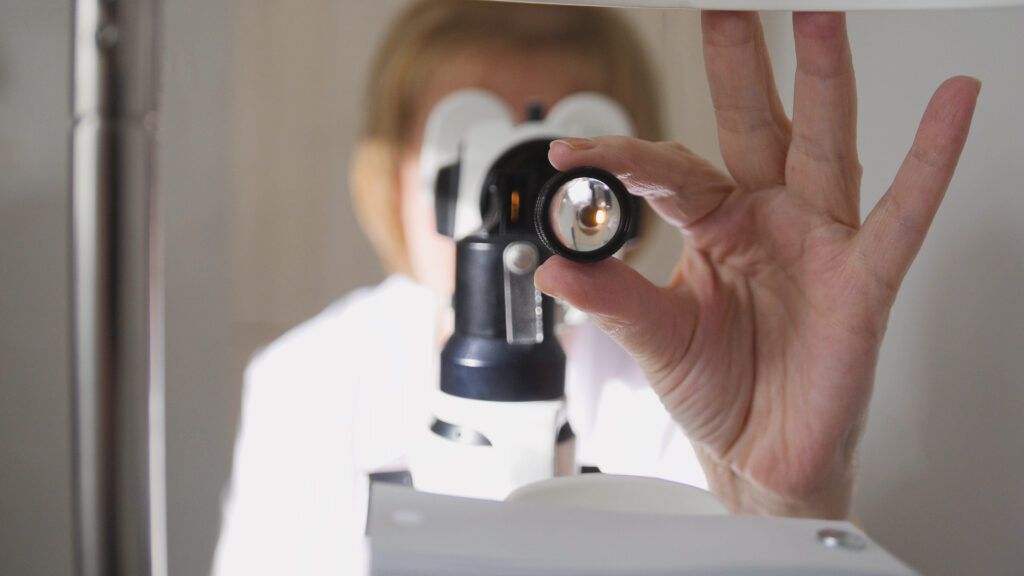
In ophthalmology, IVOM represents one of the greatest medical advances of recent decades: the intravitreal injection of medication. Better known as an "eye injection," this therapy has revolutionized treatment options for severe, vision-threatening retinal diseases. At our ophthalmology practice in Frankfurt Westend, the IVOM in ophthalmology This is a core competency of Dr. Mareen Schmidt. As an experienced retinal specialist, she performs this treatment with the utmost care and according to her patient-oriented 5-S method, which is designed for maximum safety and effectiveness.
The role of IVOM in modern ophthalmology
The introduction of the IVOM in ophthalmology This marks a paradigm shift. Diseases like wet age-related macular degeneration (AMD), which previously almost inevitably led to severe vision loss, are now treatable. Instead of passively watching the disease progress, we can now actively intervene in the disease process. This therapy gives countless people the opportunity to preserve their independence, their ability to read, and their quality of life.
IVOM in ophthalmology: The main areas of application
The IVOM in ophthalmology is a highly specialized therapy used in diseases where fluid accumulates (edema) or abnormal blood vessel growth occurs in the center of the retina (macula).
The most common indications for IVOM therapy are:
- Wet age-related macular degeneration (AMD): This is the classic and most common area of application.
- Diabetic macular edema (DME): One of the most common causes of vision loss in patients with diabetes.
- Macular edema after retinal vein occlusion: A complication following an „eye infarction“ or a „thrombosis“ in the eye.
- Inflammation inside the eye (uveitis): For rapid and targeted control of certain severe, non-infectious inflammations.
- Myopic Macular Neovascularization (mMNV): A rare condition in people with high myopia.
The principle behind IVOM: A targeted intervention in ophthalmology
The IVOM in ophthalmology The medications used are in most cases so-called VEGF inhibitors, or in specific cases, cortisone implants. The growth factor VEGF (vascular endothelial growth factor) plays a crucial and detrimental role: it promotes the growth of new, but abnormal and leaky blood vessels and makes existing vessels permeable. The IVOM medications act like a "VEGF scavenger," neutralizing this signaling molecule in the eye. This seals the vessels again, reduces swelling in the macula, and allows the retina to recover. This targeted effect makes the IVOM in ophthalmology so effective.
IVOM in ophthalmology: The treatment process according to the 5-S method
We understand the concerns associated with eye surgery. That's why every IVOM in ophthalmology In our Frankfurt practice, we follow a strictly standardized and patient-centered procedure based on our 5-S method. The procedure itself takes place at our nearby, state-of-the-art operating center in the Westend Medical Center.
- Careful preparation: We will provide you with comprehensive information. Before the procedure, your eye will be prepared by administering highly effective numbing eye drops several times until the surface is completely insensitive to pain.
- Sterile conditions: The entire procedure takes place under the strictest hygiene measures. The eye and the surrounding area are disinfected and sterilely covered.
- Gentle & low-pain implementation: A lid clamp gently holds the eye open. The injection itself, using a very fine needle, takes only a few seconds and is not painful.
- Safe aftercare: The eye pressure is checked immediately after the injection. The further aftercare of your IVOM-Treatment then takes place again in the familiar atmosphere of our practice.
IVOM in ophthalmology: a comparison of medications and their strengths
For the IVOM in ophthalmology various highly effective medications are available. The choice of the right medication is an individual decision that Dr. Mareen Schmidt will make together with you, depending on your specific illness and the course it has taken so far.
Drug (example) | Mechanism of action / special feature | Typical areas of application |
Lucentis® (ranibizumab) | Blockade of VEGF-A. Many years of proven experience. | Wet AMD, DME, vein occlusion. |
Eylea® (Aflibercept) | „VEGF trap“, binds VEGF-A and PlGF. Potentially longer action intervals. | Wet AMD, DME, vein occlusion. |
Vabysmo® (faricimab) | Dual blockade of VEGF-A and angiopoietin-2, latest generation. | Wet AMD, DME. |
Ozurdex® (dexamethasone) | Cortisone depot implant. Strong anti-inflammatory effect for months. | Uveitis, venous occlusion, refractory DME. |
Frequently asked questions about IVOM in ophthalmology
Here you will find answers to common questions that patients ask us about the IVOM in ophthalmology in our Frankfurt practice.
Is IVOM painful?
No, the IVOM in ophthalmology Thanks to our low-pain 5-S method, the procedure is painless. The intensive local anesthetic applied to the surface of the eye means you won't feel the injection itself, at most a brief, slight pressure. Our entire team is dedicated to providing you with a stress-free and comfortable treatment, which is one of our top priorities.
How often must the IVOM be repeated?
Treatment with a IVOM in ophthalmology is a long-term therapy for a chronic illness. At the beginning, a „saturation phase“ with several injections at monthly intervals is usually necessary. The treatment intervals are then individually adapted to your findings in order to achieve a stable result with as few injections as possible and to control the disease in the long term.
What are the risks and side effects of IVOM?
The IVOM in ophthalmology It is a very safe, routine procedure when performed by an expert. Common, but harmless, side effects include minor bleeding on the surface of the eye or a temporary foreign body sensation. The most serious, but very rare, complication is an infection inside the eye, which we minimize through the strictest sterile conditions during every treatment.
Can I drive after the IVOM?
No, you must not drive yourself on the day of treatment. Immediately after the IVOM in ophthalmology The treated eye's vision is impaired due to the necessary pupil dilation. Please always arrange for someone to accompany you home or take a taxi to ensure your safety.
What happens if I decide not to have IVOM treatment?
Without a consistent IVOM in ophthalmology diseases such as wet AMD or diabetic macular oedema usually progress. This leads to increasing and often irreversible damage to the retina. The result is a severe loss of central vision, the ability to read and independence in everyday life, which we want to prevent with this therapy.
How quickly does the medication work after the injection?
The effect of a IVOM in ophthalmology sets in very quickly. The first measurable improvement, such as a reduction in retinal swelling, can often be seen at the first check-up after a few days to weeks. Many patients report a stabilization or improvement in their visual impression shortly after the procedure, which demonstrates the high effectiveness of the IVOM-Therapy emphasizes.
Are both eyes injected at the same time during treatment?
Yes. A bilateral injection does not carry a higher risk of infection or complications. If it is easier for you logistically, we will treat both eyes on the same day. lung.
What do I need to be aware of at home after IVOM?
In the first few days after the IVOM in ophthalmology You should avoid rubbing your eye and prevent contact with dust or dirt. If you experience severe pain, increasing redness, or a sudden deterioration in vision, you must contact us immediately to rule out complications.
Will my health insurance cover the costs of IVOM?
Yes, the IVOM in ophthalmology For approved conditions, this treatment is a recognized benefit and is generally covered by private health insurance. While the medications are expensive, their effectiveness in preventing blindness is so well-documented that the costs of this important vision-preserving therapy are covered.
Why is the doctor's experience in IVOM so important?
The implementation of a IVOM in ophthalmology requires maximum precision, routine and the ability to optimally control the course of treatment. As a retina specialist, Dr. Mareen Schmidt has the necessary expertise to guarantee you the safest and most effective treatment. Her experience is the key to a successful and anxiety-free course of treatment, especially if repeated injections are necessary.
A modern and safe therapy for your eyesight
The IVOM in ophthalmology has revolutionized the treatment of severe retinal diseases and gives countless patients the chance to preserve their vision and thus their quality of life. At Dr. Mareen Schmidt's practice in Frankfurt, you are in the best and most experienced hands with this diagnosis. Feel free to make an appointment for a comprehensive and personal consultation, during which we will answer all your questions at your leisure.