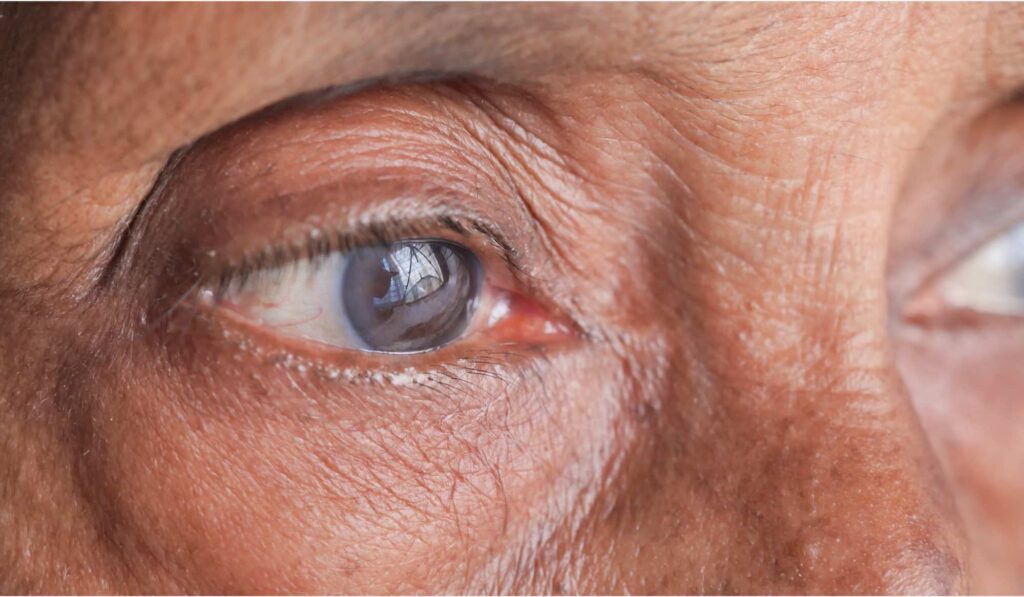
RCS Eye Injection: A diagnosis of central serous retinopathy (CSR) raises many questions for those affected, particularly regarding treatment options. While intravitreal injections (IVOM therapy) are often the first choice for other retinal diseases, RCS requires a differentiated and highly individualized approach. As your experienced retinal specialist in Frankfurt Westend, Dr. Mareen Schmidt's goal is to find the best and gentlest therapy for you after a precise diagnosis – whether through watchful waiting, modern laser treatment, or, in specific cases, targeted injection therapy.
What is central serous retinopathy (RCS)?
Central serous retinopathy, often called the "manager's disease of the eye," is a disease of the central retina (macula). For reasons that are not yet fully understood, a leak occurs in the layer beneath the retina, the choroid. This causes fluid to leak out and accumulate under the macula, making it appear as a small blister.
Since the macula is the area of sharpest vision, this leads to typical symptoms:
- Blurred or foggy vision: Often it looks like a water stain or fogged-up glasses.
- Distorted vision (metamorphopsia): Straight lines can appear wavy or bent.
- Reduced vision (micropsia): Objects in the center appear smaller than with the healthy eye.
- Altered color perception: Colors may appear paler or washed out.
Typically, men between the ages of 30 and 50 are more frequently affected, especially those under professional or personal stress. The use of cortisone preparations is also a known risk factor.
RCS Eye Syringe: Why the syringe is not always the first choice
Although the search term "RCS eye injection" is common, it's important to understand that intravitreal injection therapy (IVOM) is not the standard first-line treatment for RCS. This is due to the natural progression of the disease.
In acute, first-time RCS, in over 80% cases, the fluid spontaneously regresses and vision fully recovers within three to six months.
The primary treatment strategy is therefore, in most cases, "watchful waiting." During this phase, we support you by:
- Close monitoring: Using high-resolution OCT scans, we precisely monitor the amount of fluid and the condition of the retinal cells.
- Stress reduction: Comprehensive advice on reducing stress factors is a crucial part of the therapy.
- Drug review: We will determine if you are taking any medications containing cortisone (including nasal sprays or ointments) that should be discontinued or changed.
Active treatment is only considered if the fluid does not recede on its own and the RCS becomes chronic.
Modern treatment options for chronic RCS
If RCS becomes chronic (lasting longer than 3-6 months) or if there are repeated flare-ups, permanent damage to the retinal cells is a risk. In this case, we have modern and gentle treatment methods available.
Overview of treatment options for chronic RCS
Procedure | Operating principle | Application area at RCS |
Photodynamic therapy (PDT) | A light-sensitive dye is injected into the arm vein and then activated at the leak with a cold laser to "seal" the leak. | Gold standard for chronic RCS with clearly localizable source points. |
Micropulse laser | Short, gentle laser pulses stimulate the pumping function of the cells under the retina without damaging the tissue. | An alternative to PDT, especially in cases of diffuse leaks or when the source point is very centrally located. |
RCS eye injection (IVOM) | Medications (VEGF inhibitors) are injected into the eye to reduce vascular permeability. | An „off-label“ option for specific chronic cases where there is evidence of VEGF activity. |

The RCS eye injection as an „off-label“ therapy
The treatment of RCS with an eye injection This is a so-called "off-label use." This means the medication is not officially approved for this specific condition, although it has demonstrated good efficacy in studies and individual cases. Dr. Mareen Schmidt considers this treatment option only after careful evaluation and a particularly thorough explanation, when other procedures are unsuitable or have not yielded the desired results. Should this therapy be the best option for you, we will perform it according to the strict criteria of our 5-S method (Safe, Gentle, Minimally Painful, Sterile, Careful).
Frequently asked questions about RCS, eye and syringe
Here we answer frequently asked questions that we receive in connection with the RCS and the question of an injection in the eye be asked.
Is central serous retinopathy (CSR) dangerous?
Acute central serous chorioretinopathy (CSCR) is usually not dangerous, as it often resolves on its own. The condition becomes dangerous when it becomes chronic, because the persistent fluid buildup can permanently damage the light-sensitive cells in the retina. Therefore, careful monitoring by a retinal specialist is crucial to determine the right time for any necessary treatment. RCS at the eye Not to be missed.
Can I go blind from RCS?
Complete blindness due to central serous chorioretinopathy (CSCR) is extremely rare. The disease typically only affects central visual acuity. However, in chronic cases, it can lead to a significant and permanent impairment of reading ability and the ability to recognize details. The goal of treatment for RCS, whether with laser or syringe, is precisely to prevent this.
Is stress really the main cause of my RCS?
Stress is considered one of the most important triggers for central serous chorioretinopathy (CSCR). The stress hormone cortisol appears to increase the permeability of the blood vessels in the choroid. Many patients report that the condition occurs during periods of high professional or personal stress. Therefore, counseling on stress reduction is a key component of treatment before any further intervention is considered. Injection into the eye during RCS is being considered.
Why is the injection considered an "off-label" therapy for RCS?
„Off-label use“ means that the manufacturer is responsible for the RCS has not conducted any approval studies for the injection. The effectiveness of RCS in treating wet AMD, however, has been demonstrated in large studies. Since the scientific evidence for RCS is less strong, its use requires particularly careful patient education and an individualized decision. This is a sign of responsible medicine.
If an RCS eye injection is necessary, is it painful?
No. Should injection therapy be the best option for you? RCS at the eye If you are experiencing pain, we perform this procedure using our low-pain 5-S method. Thanks to intensive local anesthesia with eye drops, the injection itself is not painful. You will only feel a brief, slight pressure, which makes the treatment very well tolerated.
How many injections are necessary for RCS?
Unlike wet AMD, there are no treatment options for... RCS with an eye injection There is no fixed protocol. It is an individualized treatment attempt. Often, a single injection is given initially, and its effect is checked after a few weeks. Further injections are only advisable if a clear positive effect is observed.
What can I do myself to promote the healing of my RCS?
The most important measure is stress reduction. Try to avoid peak workloads and deliberately incorporate relaxation periods into your daily routine. Absolutely avoid cortisone-containing medications (including creams or nasal sprays) unless absolutely necessary, and discuss any medication you are taking with us. This is often more effective than any other approach. Injection into the eye during RCS.
Can RCS recur even after successful treatment?
Yes, unfortunately, central serous chorioretinopathy (CSCR) tends to recur in some patients. Even after complete recovery or successful treatment, fluid accumulation can occur again, often during periods of stress. Regular checkups and careful self-monitoring (e.g., using an Amsler grid) are therefore important, even if you don't notice any symptoms. RCS eye syringe need more.
What is the difference between RCS and wet AMD?
Although both conditions involve fluid under the macula, their causes are completely different. In wet AMD, abnormal blood vessels grow, requiring treatment. In RCS, there is "only" a leak, without vascular growth. Therefore, the RCS eye syringe It is not the standard therapy, whereas it is essential for wet AMD.
Why should I see a retinal specialist if I have RCS?
Diagnosing and, in particular, deciding on the treatment for retinal detachment (RCD) requires extensive experience and access to state-of-the-art diagnostic and therapeutic procedures. As a retinal specialist, Dr. Mareen Schmidt can reliably differentiate RCD from other diseases, precisely assess its progression, and utilize the full spectrum of modern therapies – from photodynamic therapy (PDT) and micropulse laser treatment to... RCS eye syringe – offer and select the best option for you.
Your individual path to clear vision
Central serous retinopathy (CSR) is a serious condition, but in most cases it has a very good prognosis when treated by an experienced specialist. We always make the decision regarding potential treatment together with you, based on precise diagnostics and honest advice. If you have been diagnosed with CSR or are experiencing typical symptoms, please feel free to schedule an appointment for a comprehensive examination with Dr. Mareen Schmidt at our Frankfurt practice.